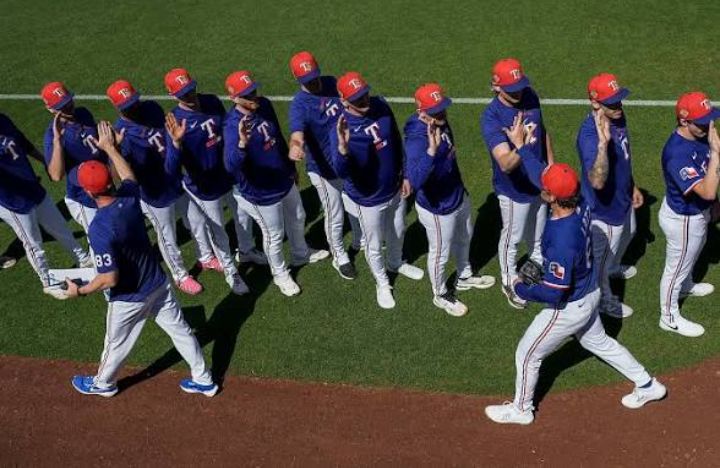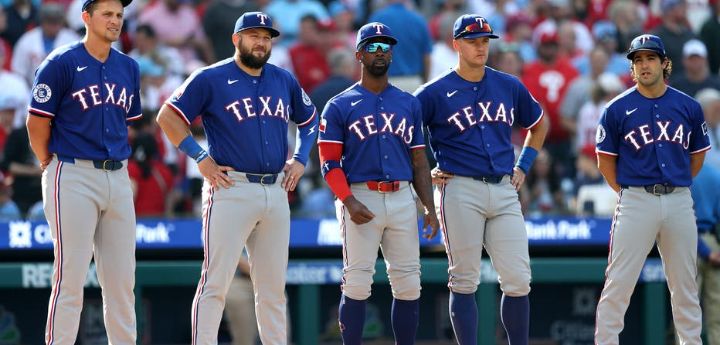
The Texas Rangers find themselves in a critical stretch of the 2026 season, and while their postseason hopes remain alive, their recent offensive struggles are becoming increasingly difficult to ignore.
Saturday’s matchup against the Los Angeles Angels was another frustrating example. Despite the importance of every remaining game, Texas managed only one hit and was shut out 3-0 at Globe Life Field. The loss highlighted a troubling trend for a club that is trying to secure a place in the American League postseason.
The defeat came on a day when the Rangers celebrated a memorable chapter in franchise history. Before the game, Texas honored the 1996 team, which became the first Rangers squad to reach the playoffs. Members of that historic roster, along with coaches, staff and executives, gathered for a special ceremony commemorating the 30th anniversary of that achievement.
Former Rangers pitcher Ken Hill, who was the club’s Pitcher of the Year in 1996, threw out the ceremonial first pitch to Hall of Fame catcher Iván Rodríguez.
The celebration offered a reminder of the franchise’s successful past, but the current Rangers are facing a very different challenge. Unlike the 1996 club, which captured the American League West with a strong regular-season performance, the 2026 Rangers are fighting to stay above the postseason cut line.
Every victory matters now, making Saturday’s offensive performance particularly concerning.
Texas was unable to generate much of anything against Angels starter Ryan Johnson. The Rangers went through the first five innings without recording a hit. Their first and only hit arrived in the sixth inning, when Cody Freeman opened the frame with a single.
Freeman eventually reached second base, putting Texas in its only scoring position of the night, but the Rangers could not bring him home.
Overall, Texas finished with only five baserunners. Freeman had the lone hit, while three players drew walks and Jake Burger reached after being hit by a pitch.
Burger’s situation added another concern to an already difficult night. The first baseman was hit and later left the game with a left wrist contusion. Initial X-rays were clean, but the Rangers will understandably monitor his condition closely given the importance of his role in the lineup.
The lack of production has become a growing problem for Texas.
Outfielder Wyatt Langford openly acknowledged the issue after the game, essentially saying that the Rangers simply have not been hitting. He suggested that the team may be putting too much pressure on individual players to solve the problem themselves rather than approaching the challenge collectively.
That assessment reflects the bigger problem facing the Rangers.
The team has now been held to one hit or fewer three times this season, the most in the American League. Saturday’s shutout was also their 10th of the year, placing them fourth in the league in that unwanted category.
Even more troubling is how quickly the offensive struggles have intensified.
Texas has been shut out twice in its last four games and three times over its last nine. That is a dramatic change from the stretch between July 5 and Aug. 12, when the Rangers were shut out only once across 32 games.
The Angels have now shut Texas out twice this month alone.
The Rangers have also scored two runs or fewer in four consecutive games. They have managed two or fewer runs in five of their last six games and eight of their last 12.
Those numbers make it clear why manager Skip Schumaker is demanding better execution from his hitters.
Schumaker emphasized that the problem is not effort. According to the Rangers manager, the players understand the situation and continue to work, but their preparation has not yet translated into results.
There is still plenty of experience inside the clubhouse, with several players who have been through postseason pressure before. However, experience alone cannot solve the problem if the offense does not begin producing.
The Rangers have attempted different approaches in an effort to break out of the slump. Some hitters have increased their work, while others have reduced their workload. The club has experimented with different batting-cage routines and game plans during meetings.
So far, however, none of those adjustments has produced the desired breakthrough.
Schumaker also avoided describing the situation as a case of hitters pressing. Instead, he pointed toward a lack of execution and acknowledged that the players know their performance needs to improve.
The encouraging part for Texas is that the postseason remains within reach.
Despite falling to 64-66, the Rangers still occupied the final American League Wild Card position following Saturday’s action. They also remained only one game behind the Houston Astros, who were 65-65, in the AL West.
That means the Rangers have not lost control of their postseason destiny.
But their margin for error is shrinking.
The club cannot afford to continue wasting opportunities while struggling to score runs. The American League playoff race is tight, and a prolonged offensive slump could quickly push Texas out of the picture.
Cody Freeman offered a more optimistic outlook after the loss, stressing that the team is focused on taking things one day and one series at a time.
That mindset could be crucial over the final portion of the season.
The Rangers do not necessarily need to fix everything at once. They need their offense to start producing consistently enough to support their pitching and capitalize on the opportunities that remain.
Meanwhile, elsewhere in the American League West, the Seattle Mariners received a major boost from an unforgettable performance by Randy Arozarena.
Arozarena delivered one of the most spectacular games of his Mariners career Saturday, helping Seattle defeat the Chicago Cubs, 5-4, with a walk-off home run.
His performance was remarkable from beginning to end.
Arozarena hit a leadoff home run earlier in the game and later produced the game-winning blast. In between those two moments, he made an incredible defensive play by robbing Chicago’s Miguel Amaya of a home run.
The performance came after Arozarena was unexpectedly moved into the leadoff spot. Brendan Donovan was scratched shortly before the game after being struck on the head by a baseball in the batting cages.
Arozarena immediately made an impact.
Facing David Peterson, he crushed a 93.5 mph sinker, sending the ball 416 feet with an exit velocity of 105.3 mph. The homer made him the fifth Seattle player to hit a leadoff home run this season and established a franchise record.
His defensive play was arguably even more impressive.
Amaya launched a towering ball toward the outfield, giving Arozarena enough time to retreat toward the warning track. With the ball carrying for more than six seconds, Arozarena timed his jump perfectly and reached over the wall with his glove to take away what appeared to be a home run.
Then came his final act.
With Seattle trailing late, the Mariners appeared to be running out of opportunities. But a double from Weston Wilson and a single from Leo Rivas suddenly put Arozarena at the plate as the potential winning run.
He fell behind with a called strike, but reliever Jacob Webb went back to a similar pitch. This time, Arozarena was ready.
He launched the ball out of the park for a dramatic walk-off victory.
The combination of a leadoff homer, a home-run robbery and a walk-off homer made the performance extraordinarily rare. Arozarena became only the seventh player in MLB history to hit both a leadoff and walk-off home run in the same game.
Even more remarkably, he joined a very small group of players who accomplished the feat on the first and final pitches their teams saw during the game.
The victory was especially important for Seattle because both Texas and Houston lost Saturday. The Mariners improved to 62-68 and moved closer in the AL West race.
For the Rangers, that result serves as another reminder of how competitive the division remains.
Texas still has a postseason path available, but the club cannot afford to let its offensive struggles continue unchecked.
The pitching staff has provided opportunities, and the standings remain favorable enough for the Rangers to make a serious push. However, postseason baseball requires timely hitting, consistent production and the ability to capitalize when opportunities arise.
Right now, those elements have been missing.
The message from inside the clubhouse is clear: the Rangers are working, they care, and they understand what is at stake. What they need now is for that effort to translate into results.
With the season moving deeper into its decisive stage, Texas has little time left to wait for the bats to come alive.
Their playoff hopes remain very much alive.
But if the Rangers want to be playing in October, the offense must find its rhythm—and quickly.