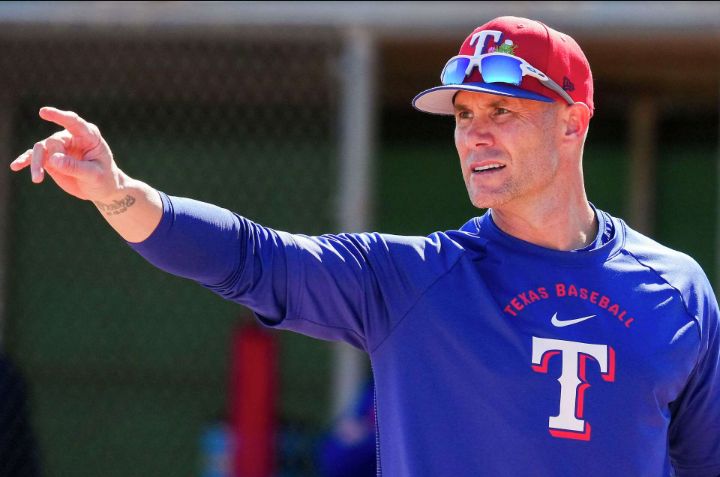
The Texas Rangers are facing increasing scrutiny as their season continues to fall short of expectations, and the focus is beginning to shift toward the coaching staff.
For a team expected to compete at a high level, inconsistent performances in both the lineup and pitching staff have raised legitimate questions about player development, preparation and in-game management. While individual struggles cannot automatically be attributed to coaching, the Rangers’ broader performance has created a situation in which organizational decisions are likely to receive greater attention.
The central question now is whether the Rangers should consider changes to their coaching structure.
Offensive Consistency Remains a Concern
One of the most noticeable issues has been the inconsistency of the Rangers’ offense.
The team has had stretches in which its lineup has struggled to produce consistently, placing additional pressure on the pitching staff. Several players who entered the season with expectations of making significant contributions have experienced difficult periods.
There are many reasons a hitter can underperform. Injuries, opposing pitching, mechanical problems, adjustments and simple fluctuations in performance can all play a role.
However, when multiple important players struggle during the same season, questions about the team’s offensive development process naturally follow.
The hitting coach is one of the individuals who comes under scrutiny in such circumstances.
A coaching staff cannot guarantee that every player will produce at an expected level. Its responsibility, however, includes helping players identify problems, make adjustments and develop approaches that allow them to perform consistently.
For the Rangers, improving offensive consistency will be an important part of addressing their broader problems.
Pitching Development Has Also Drawn Attention
The pitching staff has created another area of concern.
The Rangers have dealt with challenges involving performance, availability and consistency, while some pitchers have struggled to reproduce the level of production expected from them.
Pitching performance is particularly difficult to evaluate because it involves numerous variables. Injuries, workload, pitch selection, command, defensive support and opposing hitters can all affect results.
Nevertheless, continued struggles inevitably lead to questions about pitching development and usage.
Fans have questioned whether certain pitchers have been placed in situations that maximize their strengths and whether struggling arms have received the adjustments necessary to improve.
Those questions do not establish that the coaching staff is responsible for every pitching problem. They do, however, highlight why the organization’s pitching-development process deserves examination.
For a team with postseason ambitions, reliable pitching is essential. The Rangers need to determine whether their current approach is producing enough consistency from the staff.
Results Ultimately Drive the Conversation
The strongest argument behind the growing coaching debate is the team’s results.
Baseball is a long season, and every club experiences losing streaks. Even strong teams can struggle against opponents they were expected to beat.
The concern becomes more significant when those problems continue over an extended period.
The Rangers need to find ways to win games against teams they are capable of competing with. Losing close games occasionally is part of baseball. Repeatedly failing to capitalize on favorable opportunities, however, can expose deeper problems that the organization must address.
That is why the coaching discussion has become increasingly relevant.
Coaches are not solely responsible for wins and losses. Players must execute, the front office must construct the roster and injuries can dramatically change a team’s outlook.
But coaching remains an important part of the equation.
Should the Rangers Consider Changes?
The organization now faces an important evaluation period.
Rather than reacting solely to individual losses, Rangers leadership will need to examine the larger body of evidence. That includes player development, offensive production, pitching performance, injuries, lineup decisions and the team’s overall competitive trajectory.
If the organization determines that the current coaching structure is not producing the necessary development or consistency, changes could become part of the offseason conversation.
On the other hand, if leadership believes the underlying process remains sound and that the team’s struggles are primarily connected to injuries, player execution or roster limitations, it may choose to maintain continuity.
Either way, the evaluation should be based on more than emotion.
Accountability Will Be Important
The growing frustration among Rangers supporters reflects a broader demand for accountability.
Fans invest significant time and energy into following the team, and expectations naturally rise when an organization builds a roster designed to compete.
When those expectations are not met, supporters want to understand why.
That means the Rangers’ leadership will eventually have to answer difficult questions about what went wrong and what needs to change.
Were the players properly developed?
Did the coaching staff make effective adjustments?
Was the pitching staff used appropriately?
Did the offensive approach maximize the talent available?
And most importantly, does the organization believe the current system gives the Rangers the best chance to compete moving forward?
Those questions deserve serious consideration.
The Road Ahead
The Rangers still have an opportunity to change the narrative.
A strong finish could alter the conversation considerably. Improved offensive production, better pitching performances and more consistent execution would provide evidence that the team can correct its problems without major structural changes.
If the struggles continue, however, the pressure on the coaching staff is likely to increase.
The organization will have to determine whether the current issues represent a temporary downturn or a larger problem requiring intervention.
For now, the coaching debate is less about identifying a single person to blame and more about evaluating whether the Rangers are getting enough from their current system.
The bottom line is simple: the Rangers need results.
Talent alone does not guarantee success, and coaching alone cannot solve every problem. But when a team consistently falls short of expectations, every part of the organization must be evaluated.
That includes the coaching staff.
As the Rangers look toward the remainder of the season and beyond, the decisions made by their leadership could have significant consequences for the direction of the franchise.