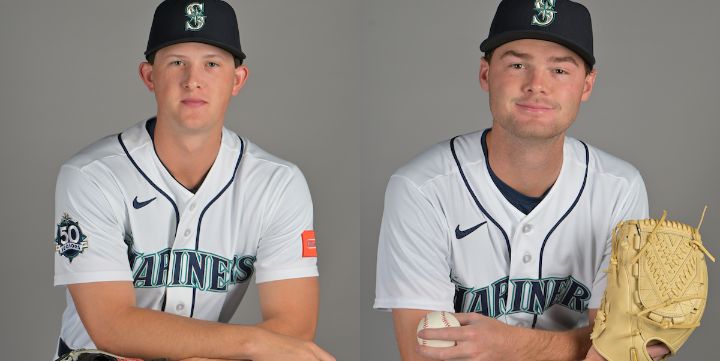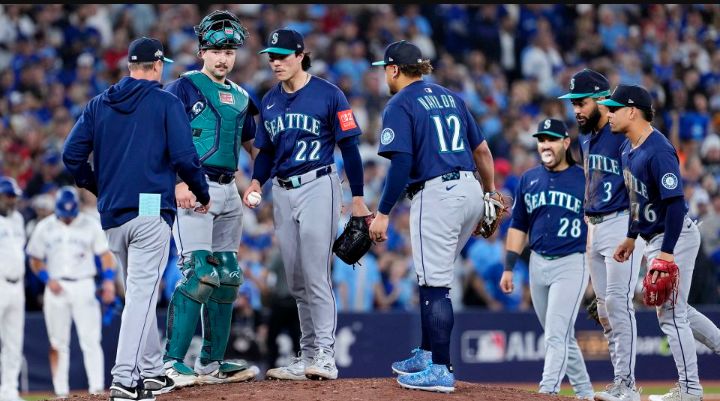
The Seattle Mariners are at a point in their season where internal adjustments are becoming increasingly necessary as they look for a spark to push them back into stronger contention. Despite remaining close in the American League West race, the team’s overall performance has not fully matched expectations, leading the organization to explore changes that could reshape both the present roster and future direction.
One of the most notable recent developments has been the promotion of highly regarded infield prospect Colt Emerson. The young infielder, who primarily plays on the left side of the infield, is viewed within the organization and around baseball circles as one of the club’s most promising long-term talents. At just 20 years old, Emerson represents the type of upside-driven player the Mariners hope can eventually become a foundational piece of their lineup. While his talent level is widely praised, there is also an understanding that his transition to Major League Baseball will likely come with expected growing pains, as is common for players of his age and experience level.
The Mariners’ decision to bring him up reflects a broader strategy of balancing immediate competitiveness with long-term development. The team has been hovering around the middle of the standings, sitting close to the top of the division but not firmly established as dominant. Their record, slightly below expectations, has created urgency within the organization to identify solutions that can improve both performance and consistency. In that context, introducing young talent like Emerson is seen as a potential way to inject energy into the roster while evaluating how future pieces might fit into the core.
However, Emerson’s arrival also creates ripple effects across the current infield structure. One of the most discussed consequences involves veteran shortstop J.P. Crawford, a long-standing member of the Mariners organization and a player who has played a central role in the team’s recent era. Crawford has been known for his leadership, defensive stability in past seasons, and patient approach at the plate. Over the years, he has developed into one of the more recognizable and established figures on the roster.
Even so, his current form has sparked debate about his long-term future with the team. Offensively, Crawford has produced respectable numbers, including a solid on-base percentage driven by his strong ability to draw walks. He has also added moderate power output, including several home runs, and has maintained a disciplined approach that limits strikeouts. On paper, those numbers suggest a player who is still contributing at a meaningful level, particularly in comparison to other shortstops around the league.
Despite that, concerns have emerged regarding his defensive performance. Advanced metrics have not been favorable, with Crawford ranking near the bottom of qualified shortstops in defensive value indicators. Over the past season and a half, his defensive rating has reportedly declined to a level that places him among the least effective defenders at his position statistically. This drop in defensive consistency has become a key talking point for analysts and fans evaluating his overall impact.
The tension in Crawford’s evaluation comes from the contrast between his offensive contributions and defensive struggles. While his bat remains productive enough to be considered above average for his position, defensive regression at a premium position like shortstop carries significant weight in roster decision-making. For a team aiming to compete at a championship level, maintaining elite defense up the middle is often viewed as essential.
This is where the emergence of Colt Emerson complicates the Mariners’ roster outlook. Although Emerson is still early in his development and far from a finished product, his presence represents a potential long-term option at an infield position. The organization is now faced with the challenge of determining how quickly he can be integrated into the lineup and what that means for existing veterans who currently occupy key roles.
Internally, discussions around roster construction often involve balancing proven experience with emerging potential. Crawford’s track record includes seasons where he performed at a very high level, including a standout year in which he led the league in walks and produced an excellent offensive profile. That version of Crawford demonstrated the value of his disciplined hitting approach and showed why the Mariners invested in him as a core player.
Because of that history, any decision involving his future would not be taken lightly. Moving on from a veteran who has contributed significantly over multiple seasons carries both performance and leadership implications. He has been part of the team’s evolution and has played through different competitive phases, making him more than just a statistical contributor.
At the same time, professional sports often require difficult roster decisions when teams attempt to maximize their long-term competitiveness. If younger players begin to show similar or higher potential, organizations are frequently forced to consider transitions earlier than expected. The Mariners’ current situation appears to be approaching that type of crossroads, where development and established production intersect in a way that demands careful evaluation.
Another factor influencing the discussion is the team’s broader performance context. While Seattle remains competitive within its division, inconsistency has prevented it from pulling ahead and establishing clear dominance. Some of the struggles have been attributed to underperformance from key players across the roster, not just Crawford. This collective inconsistency has intensified scrutiny on every position group, including the infield.
For Emerson, the opportunity represents both a challenge and a developmental milestone. He is expected to receive playing time that will allow the organization to evaluate how quickly his tools translate to the major league level. His performance will likely play a role in shaping future roster decisions, especially if he shows flashes of being ready for an expanded role sooner than anticipated.
In contrast, Crawford’s situation reflects the reality faced by many veteran players when teams begin integrating younger talent. Even productive seasons can be overshadowed by defensive decline or the presence of high-upside prospects waiting in the system. While he remains a capable hitter and experienced presence, the long-term fit becomes a question of overall value rather than isolated performance.
The Mariners’ front office now finds itself weighing several key factors: current competitiveness, defensive reliability, offensive production, and future potential. Each of these elements contributes to how the roster may evolve over the coming months. Decisions involving established players and rising prospects rarely happen quickly, but the introduction of Emerson has clearly added urgency to internal evaluations.
Ultimately, the situation highlights a familiar dynamic in professional baseball, where teams must constantly balance present needs with future planning. The Mariners are attempting to remain competitive in a tightly contested division while also developing young talent capable of sustaining long-term success. Whether that balance leads to major roster changes or gradual adjustments remains to be seen, but the presence of Colt Emerson has undeniably added a new layer to the conversation surrounding the team’s infield direction and the role of veterans like J.P. Crawford.