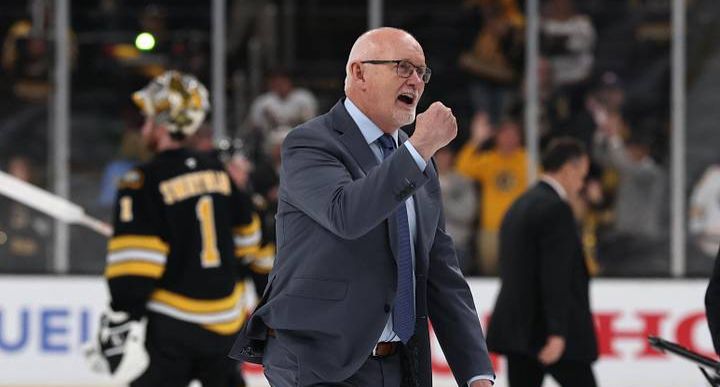
Buffalo Sabres head coach Lindy Ruff has drawn attention after making a subtle comment that many interpreted as a quiet response to remarks previously made by Boston Bruins coach Marco Sturm. The exchange stems from their first-round Stanley Cup playoff series, where pre-series comments and on-ice results created a bit of underlying tension between the two sides.
Before the series began, Sturm suggested that the Bruins would aim to play a more physical style of hockey, implying that toughness and body play could be a deciding factor against Buffalo. The statement stood out at the time because Boston entered the matchup as an underdog, facing a Sabres team widely viewed as stronger in overall depth and offensive talent. While such comments are not unusual in playoff buildup, they often take on extra meaning depending on how the series unfolds.
As the games progressed, Buffalo quickly established control of the matchup. The Sabres showed superior pace, skill execution, and consistency across all areas of play. Boston, despite showing moments of competitiveness, struggled to maintain the level required to match Buffalo over a full seven-game expectation. Eventually, the Sabres closed out the series in six games, finishing it with a decisive 4–1 victory in Game 6 at TD Garden.
That result confirmed what many analysts had observed throughout the series: Buffalo was the more complete and effective team. Their ability to adapt, generate scoring chances, and limit Boston’s offensive rhythm proved to be the difference. For the Bruins, the series exposed gaps in both depth and execution that they were unable to fully overcome.
After eliminating Boston, Buffalo shifted its focus toward preparation for the second round of the playoffs, where they were set to face the Montreal Canadiens. However, even as the Sabres moved forward in the postseason, attention lingered on comments made during the previous series.
During a media session ahead of Game 1 against Montreal, Lindy Ruff was asked questions about the upcoming matchup, particularly regarding how physical he expected the series to be. In his response, Ruff remarked that he needed to be “careful” when answering questions about bigger and stronger teams. Though the statement appeared neutral on the surface, it was widely interpreted as a subtle dig directed back at Sturm’s earlier comments.
Rather than directly criticizing the Bruins coach, Ruff’s wording suggested awareness of the narrative that had developed during the previous round. His comment implied that discussions about physical dominance had been overstated, especially given how the series actually played out in favor of Buffalo’s skill and structure. It was less an outright attack and more a pointed reminder of the outcome.
Still, Ruff’s focus appeared to remain on the present challenge. He emphasized that Montreal presents a different type of opponent compared to Boston. While the Bruins relied heavily on structure and physical play, the Canadiens are viewed as a more skilled and balanced team capable of matching Buffalo in speed and technical ability. This shift in opposition means the Sabres cannot rely solely on what worked in the previous round.
Ruff stressed that playoff success becomes increasingly difficult as teams advance. Each round introduces stronger competition, tighter margins, and fewer mistakes. Against Montreal, Buffalo would need to elevate its performance even further, particularly in defensive consistency and special teams execution. The coach’s message was clear: past success would not guarantee future results.
The Sabres’ progression to the second round marks an important step in their postseason journey. The team has shown growth, resilience, and the ability to handle pressure situations, but the intensity of playoff hockey increases significantly with each series. Montreal, known for its disciplined structure and ability to capitalize on mistakes, is expected to test Buffalo in ways Boston could not.
Meanwhile, the earlier series against the Bruins continues to be a talking point because of the contrast between pre-series expectations and actual outcomes. Boston’s attempt to establish a physical identity did not translate into sustained success, while Buffalo’s more balanced approach allowed them to control games more effectively. That contrast is what gave added weight to Ruff’s recent comments.
Within playoff hockey culture, verbal exchanges and subtle remarks are often part of the psychological layer of competition. Coaches and players frequently use media interactions to send indirect messages, build narratives, or apply pressure without making direct confrontations. Ruff’s statement fits into that pattern, as it reflects both awareness of past commentary and an effort to shift focus back to performance.
At the same time, experienced coaches like Ruff typically avoid getting too deeply involved in media-driven storylines. His reputation in the league is built on long-term experience, playoff knowledge, and a focus on preparation. As a result, even when his comments are interpreted as pointed or strategic, they often serve a dual purpose: acknowledging outside narratives while reinforcing internal focus.
As Buffalo prepares for Montreal, the emphasis inside the locker room is expected to remain on execution rather than external conversations. Playoff series at this stage are often decided by small details such as goaltending consistency, power play efficiency, defensive structure, and the ability to handle momentum swings. Ruff’s comments reflect an understanding that distractions, even subtle ones, can shift focus away from these critical factors.
For Montreal, the matchup represents an opportunity to test themselves against a high-performing Buffalo team that has already shown it can handle playoff pressure. For the Sabres, it is a chance to continue building momentum and prove that their success against Boston was not just a product of matchup advantages, but part of a deeper playoff identity.
Ultimately, the exchange between Ruff and Sturm adds a layer of narrative to an already competitive postseason. While Boston has been eliminated, the comments exchanged during the series continue to echo as Buffalo moves forward. However, in the context of playoff hockey, the only factor that truly matters is performance on the ice. Ruff’s subtle remarks may have added intrigue, but the Sabres’ attention remains firmly fixed on advancing further in the pursuit of the Stanley Cup.