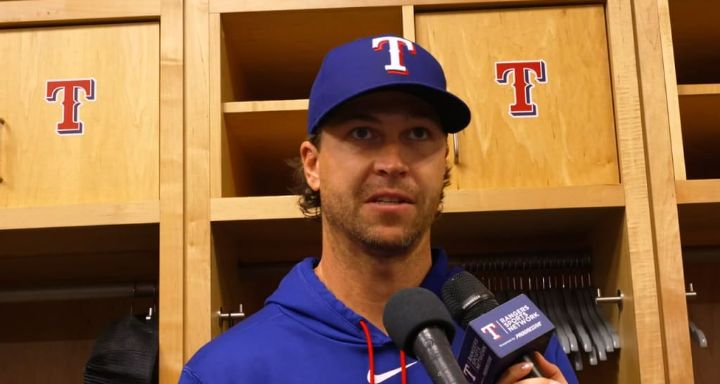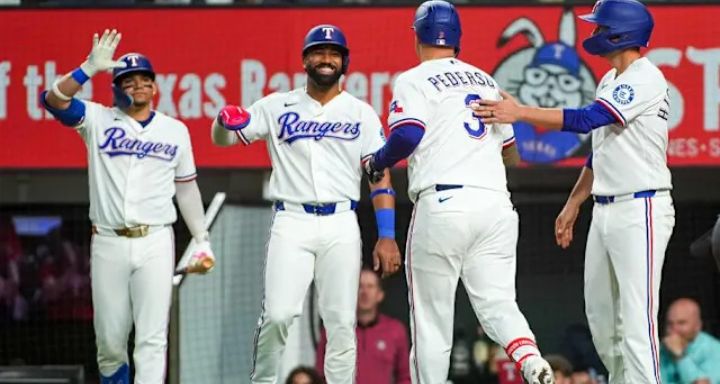
The Texas Rangers are facing another injury concern that could impact both their lineup and their plans ahead of the MLB trade deadline. Third baseman Josh Jung appears to be trending toward a stint on the injured list after failing to make the progress the team had hoped for following a calf injury earlier this week.
Jung, one of the Rangers’ most productive hitters this season, exited Tuesday’s game after suffering discomfort in his left calf while running the bases. At the time, there was optimism that the injury was relatively minor and that a couple of days of rest would be enough to get him back on the field. Instead, the recovery has moved slower than expected, creating growing concern within the organization.
The Rangers gave Jung every opportunity to recover naturally. He missed Wednesday’s game after leaving Tuesday’s contest early, and Thursday’s scheduled off day provided an additional chance for the calf to heal. By Friday, the expectation was that the 28-year-old would show enough improvement to return to baseball activities and potentially rejoin the lineup.
Unfortunately for Texas, that did not happen.
Before Friday’s game, Jung went through running drills and other baseball workouts as the Rangers evaluated whether he was healthy enough to play. Although he was able to participate in some activities, it quickly became clear that he was still dealing with significant limitations. Most notably, Jung could not run anywhere close to full speed.
Manager Skip Schumaker provided an honest assessment after watching Jung during pregame workouts. According to the Rangers manager, Jung was operating at roughly half of his normal sprinting ability, a level that simply isn’t sufficient for a player expected to contribute every day at the major league level.
For an infielder, mobility is essential. Third basemen must react quickly to hard-hit balls, charge slow rollers, move laterally to both sides, and make strong throws from different angles. Offensively, they must also be capable of running the bases aggressively, stretching singles into doubles when possible, and avoiding further injury while hustling down the first-base line.
Schumaker acknowledged that Jung simply wasn’t capable of performing those responsibilities at the necessary level.
After observing Jung’s running session, the manager admitted the Rangers face a difficult reality. While the third baseman may still be capable of swinging the bat, baseball requires much more than hitting alone. A player who cannot run at full speed limits the team’s flexibility throughout an entire game.
Schumaker explained that it becomes extremely difficult to justify keeping an injured player on the active roster when he cannot sprint. Every roster spot becomes increasingly valuable during a competitive stretch of the season, particularly with important divisional games and the trade deadline approaching.
The Rangers have considered whether Jung could remain available in a limited capacity as a pinch-hitter. Because batting places less stress on the injured calf than running or playing defense, that option has not been completely ruled out.
However, Schumaker’s comments suggested the club is preparing for a more significant roster move. Carrying a player who is unavailable for defensive duties and cannot run the bases leaves the Rangers effectively playing with a short bench, something few teams are willing to do over the course of an entire series.
As a result, the possibility of placing Jung on the injured list has become increasingly realistic.
Schumaker indicated that the organization would likely need to make a decision sooner rather than later. Waiting too long could leave the Rangers shorthanded if Jung remains unable to contribute during the weekend series against the Seattle Mariners.
To compensate for Jung’s absence, Ezequiel Duran received the start at third base. While Duran provides valuable versatility and experience, replacing Jung’s overall production is no easy task.
Jung has developed into one of the Rangers’ most reliable offensive contributors this season. He has consistently delivered quality at-bats while providing stability in the middle of Texas’ lineup. His combination of contact hitting, extra-base power, and run production has made him one of the club’s key pieces during the 2026 campaign.
His absence would be particularly frustrating because the Rangers have already dealt with numerous injuries involving important players throughout the season. Losing another everyday starter would create additional pressure on both the lineup and the bench as Texas continues fighting for postseason positioning.
The timing also couldn’t be much more challenging.
With the MLB trade deadline approaching on Aug. 3, every injury carries additional significance. Front offices across baseball are actively evaluating roster needs, determining whether to buy, sell, or stand pat before the deadline passes.
If Jung requires only the minimum injured list stay, the Rangers may decide that their current roster can withstand his absence without making a significant move.
However, should medical evaluations suggest a longer recovery period, Texas could begin exploring additional options to strengthen its infield depth before the deadline.
The Rangers have already been connected to several potential trade targets in recent weeks, and another injury to a core player could increase the urgency of acquiring reinforcements.
At the same time, the organization remains hopeful that Jung’s calf injury proves to be temporary rather than something that sidelines him for an extended period. Soft-tissue injuries can sometimes improve quickly with proper treatment and rest, but they also carry the risk of worsening if a player returns too soon.
That is likely why the Rangers have chosen to remain cautious throughout the process. Rather than rushing Jung back into action simply because of the team’s immediate needs, the organization appears focused on ensuring he is fully healthy before returning him to regular game action.
This conservative approach could ultimately benefit both Jung and the Rangers over the remainder of the season. A healthy Jung offers significantly more value over the final months than one who continues battling recurring calf problems.
Meanwhile, the Rangers received some encouraging news elsewhere on the injury front as Corey Seager continued making progress in his own rehabilitation. Although Seager’s recovery is moving in the right direction, the positive development is tempered by the uncertainty surrounding Jung.
It creates an unusual situation where one cornerstone player appears close to returning just as another may be headed for the injured list.
For the Rangers, maintaining roster balance during this stretch will be critical. If Seager returns soon, his presence could help offset some of the offensive production potentially lost with Jung’s absence. Even so, replacing Jung’s defensive reliability and consistent contributions at third base will remain a difficult challenge.
Over the next several days, all eyes will be on Jung’s recovery. The Rangers will continue evaluating his ability to run, field, and move without discomfort before determining whether an injured list assignment is necessary.
Based on Schumaker’s latest comments, however, the outlook is becoming increasingly clear. Unless Jung experiences a dramatic improvement in his calf over the next day or two, the Rangers appear poised to place one of their most important infielders on the injured list.
Such a move would allow Texas to add a healthy player to the active roster while giving Jung the time he needs to fully recover. Although losing a player of his caliber would be a significant setback, the Rangers understand that protecting his long-term health is the priority.
As the club pushes toward the trade deadline and continues its pursuit of a postseason berth, Jung’s recovery timeline may become one of the most important storylines surrounding the Rangers over the coming week.