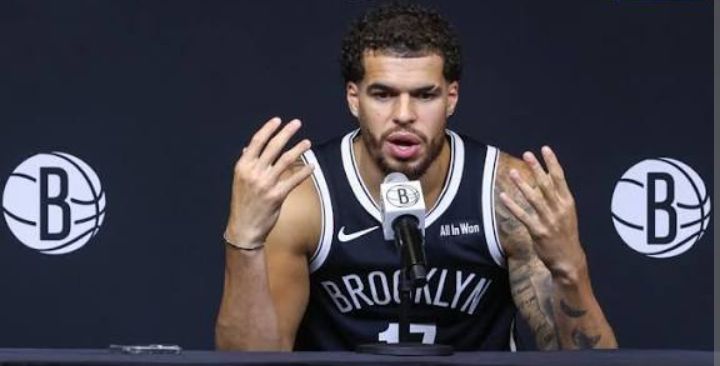
In the ever-unpredictable narrative of an NBA season, the sudden absence of a key player can cast a long shadow, shifting the dynamics of a single game and prompting broader reflections on a team’s present and future. Such is the case for the Brooklyn Nets as they prepare to face the Detroit Pistons without forward Michael Porter Jr., who has been ruled out for personal reasons related to a family matter. This development, while rooted in the private sphere of the athlete’s life, resonates through the public dimensions of the sport, touching on themes of team chemistry, individual career trajectory, and the delicate calculus of franchise building.
First and foremost, the focus rightly remains on Porter Jr. the person, rather than Porter Jr. the player. In an era of constant speculation and noise, the clarification that his absence is due to a personal family issue—and not, as some might immediately assume, impending trade negotiations—is a necessary reminder of the human element at the core of professional sports. Athletes, despite their superhuman physical gifts, navigate the same personal challenges and family concerns as anyone else. The well-wishes extended to Porter and his family by the organization and fans underscore a fundamental decency that exists alongside the competitive fervor of the league. His return will be welcomed whenever he is ready and able, on a timeline dictated by personal, not professional, necessity.
This absence, however, occurs at a pivotal moment in Porter’s own career narrative. The 2025-26 season has been a revelation for the gifted scorer, representing a culmination of his talent and a dramatic shift in his professional environment. After beginning his career with the Denver Nuggets, where he operated as a lethal but often tertiary option behind superstars Nikola Jokić and Jamal Murray, Porter has found a different kind of freedom in Brooklyn. With the Nets in a transitional phase, his role has expanded from a premium spot-up shooter into a primary offensive engine. The statistics bear this out: he is posting career-high averages in points, rebounds, and likely other categories, finally shouldering the offensive responsibility his scoring prowess always suggested he could handle.
This breakout individual performance creates a compelling, if complicated, storyline for the Nets as a franchise. On one hand, Porter Jr. is demonstrating that he can be a cornerstone—a go-to scorer whose offensive toolkit can anchor a half-court offense. In a league perpetually searching for elite shot creation, a player with his size, shooting stroke, and improving all-around game is a rare and valuable commodity. For a Nets team looking to climb back into Eastern Conference relevance, developing a young(ish) star like Porter seems like a logical, even essential, path forward. He could very well be the foundational piece around which a new competitive core is assembled, a beacon of high-level talent during a rebuild.
On the other hand, his stellar play and the team’s overall struggles have placed him squarely in the eye of the trade rumor hurricane. This is the inevitable tension for a standout performer on a non-contending team. Every missed game, regardless of the cause, will be scrutinized for whispers of a deal. Every highlight-reel performance increases his value on the open market. The Nets’ front office is undoubtedly engaged in a complex valuation exercise. Is Michael Porter Jr. the face of the next great Nets team? Or is he their most valuable trade chip, an asset that could be converted into multiple future draft picks, promising young players, or a combination thereof to accelerate a more comprehensive rebuild?
The arguments for each path are persuasive. Advocates for keeping him would point to the difficulty of acquiring a player of his offensive ceiling. He is in his prime, under team control, and has proven he can carry a significant scoring load. Building through the draft is inherently uncertain, and trading a known star for potential can backfire if those assets don’t materialize. Furthermore, his presence gives the team an identity and a reason for fans to tune in—a gifted scorer capable of explosive performances on any given night.
Conversely, the case for exploring a trade is rooted in strategic team construction and timeline management. If the Nets’ brass believes they are more than one star away from contention, accumulating future assets provides greater flexibility. A player of Porter’s caliber could command a hefty return from a contending team desperate for one more piece, potentially netting the Nets a package that includes a promising young player and unprotected first-round picks. This route accepts a step back in the immediate term for what is hoped to be a leap forward in the years to come. It is a cold but common calculus in professional sports: leverage present-day value for future potential.
Porter’s current situation, therefore, exists at the intersection of these competing narratives. His personal hiatus momentarily pauses both the on-court spectacle of his career year and the off-court speculation about his future. It creates a brief vacuum in the Nets’ lineup that other players must fill, offering a glimpse of what the team might look like without him. For the front office, it is a moment to ponder his irreplaceable value to the current roster, which becomes most apparent in his absence.
When he returns, the dual narrative will resume. Each step-back three, each slash to the basket, each high-scoring night will be celebrated by fans and analyzed by executives, both in Brooklyn and in other cities. His performance will directly influence his trade value and the Nets’ own valuation of him. The very skills that make him so captivating to watch—his effortless scoring ability—are what make his future with the franchise such an open question.
In the end, the story of Michael Porter Jr. and the Brooklyn Nets this season is a classic sports tale of individual brilliance amidst collective struggle. It is about a player seizing an opportunity and transforming his career, while the organization that provided that opportunity must decide how to best parlay that transformation into long-term success. His current absence for family reasons is a poignant reminder of the life that exists outside the arena lights. But upon his return, the basketball story will continue to unfold, a saga of points, potential, and the difficult decisions that define the path of an NBA franchise. Whether he remains a Net or becomes the key to a new future elsewhere, this season has solidified his status as a premier NBA scorer, and his journey will be one of the most closely watched subplots as the league moves toward the trade deadline and beyond.