Kentucky football has suffered a major setback ahead of the 2026 season after head coach Will Stein confirmed that transfer edge rusher Antonio O’Berry will not be eligible to play for the Wildcats this year.
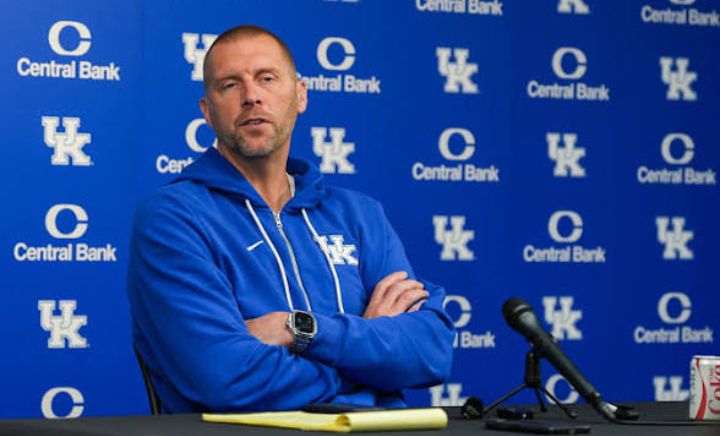
“The NCAA has notified us that Antonio O’Berry has exhausted his college eligibility,” Stein said, adding that Kentucky explored every available option in an effort to find a solution. The coach also praised O’Berry as both a person and player while wishing him well moving forward.
For Kentucky, the ruling represents a particularly frustrating development because O’Berry had been viewed as an important addition to the defense. The 6-foot-6, 240-pound edge defender transferred to the Wildcats from Gardner-Webb after building a strong reputation as a disruptive pass rusher. He entered Kentucky’s program with the potential to make an immediate impact in his first season at the FBS level.
O’Berry’s path to Kentucky was far from conventional. He began his college career at Tiffin, a Division II program in Ohio, before eventually moving to Gardner-Webb. His time at Tiffin helped him develop into a more productive defensive player, and a breakout campaign eventually created an opportunity for him at the FCS level.
At Gardner-Webb, O’Berry continued to develop into one of the more productive defenders on the roster. During the 2025 season, he recorded 52 tackles, 10.5 tackles for loss and 9.5 sacks while generating significant pressure against opposing quarterbacks. His production attracted attention from programs at the highest level of college football, ultimately leading him to enter the transfer portal.
Kentucky won his commitment over other major programs, including Ohio State and West Virginia. The Wildcats believed they had landed a player capable of strengthening their pass rush and giving the defense another experienced option on the edge.
That optimism continued into the offseason. O’Berry received considerable praise from Kentucky’s coaching staff, while his performance also attracted attention from evaluators. Pro Football Focus ranked him among the highest-graded returning SEC edge rushers, giving him an 83.6 grade. Only Texas star Colin Simmons ranked ahead of him on the list.
The recognition demonstrated just how much potential O’Berry appeared to bring to Lexington. Although he had never played an FBS snap, his production at Gardner-Webb suggested that he could make the transition successfully.
Kentucky defensive coordinator Jay Bateman had previously expressed confidence in O’Berry and indicated that NFL scouts had already begun asking about him. That level of outside interest added to expectations surrounding the transfer.
Unfortunately for both O’Berry and Kentucky, the eligibility issue eventually became impossible to overcome.
The NCAA’s new eligibility framework has created uncertainty for a number of veteran college players. Under the current “5-for-5” approach, athletes generally have a five-year window to compete in college athletics. Unlike some previous situations, the policy does not provide broad exceptions based on injuries, redshirts or other hardships.
O’Berry’s college career included three seasons at Tiffin and two seasons at Gardner-Webb, meaning the NCAA determined that his five-year window had already been exhausted. As a result, the transfer to Kentucky could not lead to an additional playing season.
The timing makes the decision even more difficult. Kentucky had already begun preparing for the upcoming season, and O’Berry was expected to compete for a significant role within the defensive front. Instead of preparing for his FBS debut, he must now consider what comes next after the NCAA ruling.
Stein acknowledged that the situation is understandably difficult for the player. The Kentucky coach also made clear that the ruling does not necessarily mean O’Berry’s football journey has to end completely. His talent and production could still create opportunities beyond college football.
From Kentucky’s perspective, however, the focus now shifts to the players who remain available.
Bateman indicated that the Wildcats still have confidence in their defensive personnel. Lorenzo Cowan, CJ Works and Sam Greene are among the players expected to take on greater responsibility following O’Berry’s removal from the lineup. Tony Washington Jr. will also be involved in developing the group.
That means Kentucky must quickly adjust its plans. Losing an experienced pass rusher who had generated 9.5 sacks and 72 pressures during his final Gardner-Webb season creates a noticeable hole, particularly for a team that expected him to provide immediate production.
Still, the coaching staff appears determined not to allow the ruling to derail the entire defensive unit.
The situation also highlights the complicated nature of college football eligibility in the current transfer era. Players can move between Division II, FCS and FBS programs, but their eligibility does not necessarily reset when they transfer. For athletes with unconventional college careers, determining how much eligibility remains can become a complicated process.
O’Berry’s case is a clear example of those challenges. His transfer to Kentucky generated excitement because he had already demonstrated his ability to disrupt offenses at Gardner-Webb. Yet his previous years in college ultimately meant that the opportunity to play at the FBS level would not materialize.
For Kentucky fans, the news is undoubtedly disappointing. O’Berry was viewed as one of the more intriguing additions to the roster, and his size, experience and pass-rushing ability had created optimism about what he could bring to the defense.
Instead, his Kentucky career will end before he ever takes a meaningful snap for the Wildcats.
Stein and the coaching staff can only move forward from the decision. The NCAA has made its determination, Kentucky explored its available options, and the Wildcats now have to prepare for the season without one of their most anticipated transfers.
For O’Berry, the disappointment is significant, but his football résumé remains impressive. He went from Division II football at Tiffin to becoming a productive FCS defender at Gardner-Webb before earning an opportunity to join an SEC program. Even though he will not get the chance to play for Kentucky, the talent that attracted the Wildcats in the first place remains evident.
The 2026 season will therefore move forward without Antonio O’Berry on Kentucky’s defense. His absence creates an unexpected challenge for Stein and Bateman, but it also gives other defensive players an opportunity to step into larger roles.
Kentucky will now have to find a way to replace the production and potential that O’Berry was expected to provide. Meanwhile, O’Berry faces an uncertain next chapter after an NCAA decision brought his collegiate playing career to an unexpected conclusion.