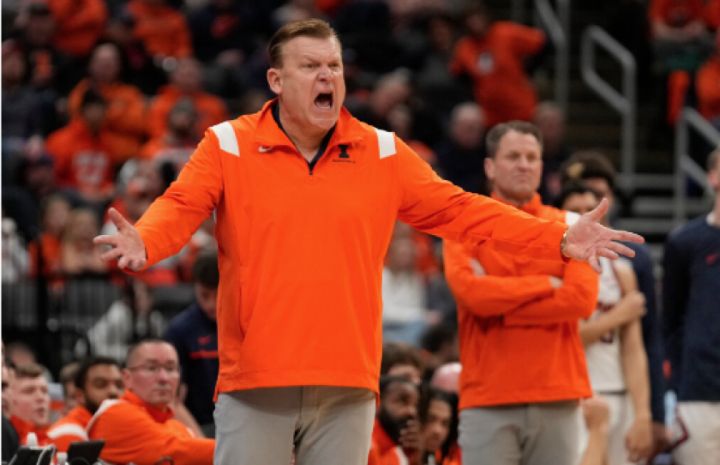
Following a historic Final Four appearance, the University of Illinois moved quickly to reward head basketball coach Brad Underwood with a major contract extension designed to keep him in Champaign for years to come. The agreement reflects how far the Fighting Illini program has risen under his leadership and signals the university’s commitment to remaining one of the top programs in college basketball.
Illinois officials announced that Underwood’s current deal, which already runs through the 2031-32 season, could now stretch as far as 2036 depending on team performance over the next several seasons. Financial details were not fully released publicly, but school officials confirmed the revised terms would place him among the highest-paid coaches in the sport.
The extension came shortly after Illinois completed one of its best seasons in decades. The Illini made a deep NCAA Tournament run and reached the Final Four for the first time in 21 years, reestablishing the program as a national contender. Underwood’s success over the past several seasons helped transform Illinois from a struggling Big Ten program into a consistent championship threat.
Athletic director Josh Whitman praised Underwood for elevating the basketball program to elite status. Whitman credited the coach with restoring energy around Illinois basketball, strengthening fan support, and creating a culture capable of competing at the highest level of college athletics. School leadership believes continuity is essential as the landscape of college sports becomes increasingly competitive due to NIL opportunities, conference expansion, and transfer portal movement.
Underwood expressed gratitude for the university’s trust and support. He emphasized that the extension is not only a reward for him personally but also recognition of the players, assistants, staff members, and loyal supporters who helped rebuild the program. He also made it clear that Illinois is not satisfied with simply reaching the Final Four and that the ultimate goal remains winning a national championship.
The revised contract reportedly includes performance-based incentives that could automatically add extra years onto the agreement. That structure gives Illinois stability while rewarding sustained success on the court. Similar contract setups have become more common in major college athletics as schools attempt to keep successful coaches away from rival programs and professional opportunities.
Illinois has enjoyed remarkable consistency under Underwood. Since arriving in 2017, he has guided the Illini to multiple NCAA Tournament appearances, conference titles, and several 20-win seasons. The program has also become one of the Big Ten’s toughest teams both offensively and defensively. His teams have developed a reputation for toughness, discipline, and physical play, characteristics that helped Illinois regain national respect.
The extension also reflects the growing financial arms race in college basketball. Coaching salaries continue to rise rapidly across the country, particularly for coaches who consistently lead teams deep into March Madness. Reports indicate Underwood was already earning millions annually before bonuses, and the updated contract is expected to raise that number significantly.
Illinois administrators clearly wanted to avoid any uncertainty surrounding Underwood’s future. After the Final Four run, many believed other major programs could potentially show interest in hiring him. By moving quickly on an extension, Illinois demonstrated its intention to keep stability within the program while continuing to build around the momentum generated this past season.
Another major part of the discussion surrounding the contract involved assistant coach compensation. Reports indicated Illinois also planned salary increases for several assistant coaches and support staff members. Keeping a strong coaching staff together has become increasingly important in modern college basketball, especially with constant roster turnover and aggressive recruiting battles nationwide. Strong assistant coaches play a huge role in player development, scouting, recruiting, and maintaining locker-room culture.
The university’s willingness to invest heavily in the entire coaching structure sends a message that Illinois intends to remain competitive nationally. Programs that consistently succeed in today’s environment often rely on experienced staffs with strong recruiting networks and player relationship skills. Illinois appears committed to maintaining that advantage moving forward.
Underwood’s journey at Illinois has not always been smooth. His early years included rebuilding seasons and frustration from fans who desperately wanted the program to return to national relevance. However, patience from university leadership eventually paid off. Recruiting improved, player development accelerated, and Illinois slowly became one of the strongest teams in the Big Ten.
Many Illinois fans now view Underwood as one of the most important coaches in modern school history. His teams have brought excitement back to the fan base and regularly filled arenas with passionate supporters. The recent Final Four appearance only strengthened that bond between the coach and the community.
Reaction across the college basketball world was largely positive. Analysts and fans widely agreed Illinois made the correct decision by locking up Underwood long-term after the success he delivered. Some online discussions highlighted how dramatically perceptions of the program have changed during his tenure. Several years ago, Illinois was struggling for consistency, but now it is regularly discussed among the nation’s elite basketball programs.
Even with the praise, expectations moving forward will be enormous. Once a program reaches the Final Four, fans naturally begin expecting regular deep tournament runs. Illinois will now face the pressure of proving this season was not a one-time breakthrough but rather the beginning of a sustained championship era. Underwood understands those expectations and appears eager to embrace them.
The contract extension ultimately represents far more than a financial agreement. It symbolizes Illinois’ belief that Underwood is the right leader to guide the program into the future. With increased investment, national recognition, strong recruiting momentum, and renewed confidence across the fan base, Illinois basketball appears positioned to remain a major force in college basketball for years to come.