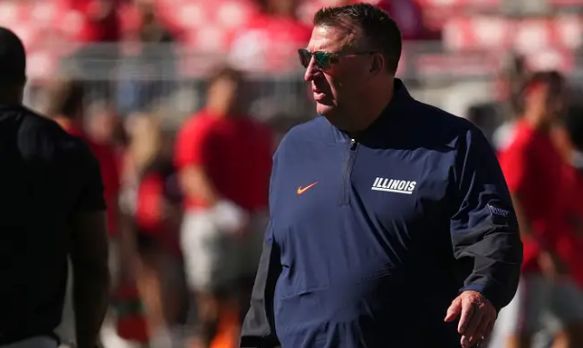
The Illinois Fighting Illini have made a major change to their coaching staff only four games into the 2026 college football season, with defensive coordinator Bobby Hauck and the program agreeing to part ways.
While an in-season coaching departure is rarely an ideal situation, the timing could ultimately give Illinois an opportunity to correct its defensive problems before they become even more difficult to address.
The decision comes after a difficult beginning to the season for the Illinois defense. The unit struggled in several important statistical categories, while some of the expectations surrounding Hauck’s arrival failed to translate into consistent results on the field.
For Illinois head coach Bret Bielema, the change represents an opportunity to make adjustments while there is still plenty of football remaining on the schedule.
Illinois could not afford to wait much longer
When a team enters a season with expectations for its defense to improve, patience is naturally part of the process. New coordinators often need time to install their systems, teach players new responsibilities and establish an identity.
However, Illinois’ defensive struggles became difficult to overlook.
The unit entered the season with expectations that it would play fast, create turnovers and make life difficult for opposing offenses. Instead, the defense struggled to consistently deliver those results.
There were also moments when Illinois appeared to have personnel issues on the field, adding to the frustration surrounding the unit.
Rather than allowing those problems to continue throughout the season, Illinois made a significant decision early enough to potentially change the direction of the defense.
Bielema previously indicated that removing Hauck was not something he had originally planned to do. Nevertheless, the circumstances surrounding the start of the season ultimately resulted in the two sides moving in different directions.
The timing is particularly significant because Illinois still has an opportunity to make something of the 2026 campaign.
The season is far from over
It would be easy to look at Illinois’ defensive struggles and assume that the season is already headed in the wrong direction. However, the problems on one side of the football do not necessarily mean the entire team has failed.
Illinois has demonstrated that its offense can compete against challenging opponents.
There have been stretches in which the offense has put together impressive drives and shown the ability to move the football against quality defenses. That gives the Illini something to build around as they move forward.
The immediate challenge will be finding a way to make the defense more reliable.
Players such as Matthew Bailey and Xavier Scott provide Illinois with experienced and talented pieces on the defensive side. A change in leadership could give those players an opportunity to perform in a system that better utilizes their strengths.
The goal does not necessarily have to be transforming the defense overnight. Illinois simply needs to become more consistent, limit mistakes and give its offense more opportunities to win games.
That is why the timing of the coaching change could matter so much.
Illinois learned from its previous experience
This is not the first time Illinois has faced questions about how long it should stick with a defensive coordinator.
The program previously worked with Aaron Henry, and there was a perception that Illinois remained with that arrangement for too long before making a change.
That situation eventually became part of the frustration surrounding the 2025 season, when the Illini fell short of expectations.
The latest decision suggests that Illinois was unwilling to allow another defensive situation to drag on without intervention.
From a program-building perspective, making a difficult decision early can sometimes provide more opportunities than waiting until an entire season has passed.
Illinois now has time to evaluate what is working, determine what needs to change and begin planning for the future.
Young players could benefit from the change
Perhaps one of the biggest potential benefits of the coaching change involves Illinois’ younger players.
The program has brought in a strong freshman class, including several players on the defensive side of the football. Developing those players will be important for the long-term direction of the program.
Young defensive players need a system that allows them to understand their assignments, play confidently and develop throughout the season.
A defensive scheme that is not producing consistent results can make that development more difficult.
With a new direction, Illinois has an opportunity to evaluate its younger defensive talent and determine how best to utilize those players moving forward.
That does not guarantee immediate success, but it gives the coaching staff an opportunity to make adjustments while those players are still early in their college careers.
The long-term impact could therefore be more important than what happens during the remaining weeks of the 2026 season.
The search for a new defensive coordinator begins
Another important consequence of Hauck’s departure is that Illinois now has additional time to evaluate potential candidates for the permanent defensive coordinator position.
Finding the right replacement will be one of the most important decisions facing Bielema.
Illinois needs a defensive coach who can establish a clear identity, develop young talent and build a system that can remain in place for multiple seasons.
Continuity has significant value in college football. Constantly changing coordinators can make it difficult for players to develop within a consistent system, while recruiting and player development can also be affected.
For that reason, Illinois will want its next defensive coordinator to be more than a short-term solution.
The program needs someone capable of becoming an important part of Bielema’s broader vision.
A successful rebuild will take more than one change
Although Hauck’s departure provides Illinois with an opportunity, the coaching change alone will not solve every problem.
The players will still have to execute.
The coaching staff will need to determine which defensive concepts should remain and which ones need to be replaced. Personnel decisions will also become increasingly important as Illinois evaluates the talent available on its roster.
Communication and discipline must improve as well.
If Illinois can address those areas, the defense could potentially become more competitive as the season progresses.
The key is that the program now has an opportunity to respond instead of allowing the same problems to continue unchecked.
Bielema faces an important decision
For Bielema, the next defensive coordinator hire could have significant consequences for the future of Illinois football.
The head coach has been working to build Illinois into a more competitive program, and defensive stability will be an important component of that effort.
The program cannot afford to repeatedly make short-term defensive hires without establishing long-term continuity.
The next coordinator will therefore be expected to do more than simply improve the numbers.
That coach will need to recruit effectively, develop players, create a recognizable defensive identity and work within Bielema’s overall program structure.
Illinois also has the benefit of beginning that search earlier than it otherwise might have.
Instead of waiting until the conclusion of the season to begin evaluating candidates, the program can spend the coming months studying potential options and determining which coaching philosophies fit its roster.
Illinois still has time to change the story
The biggest takeaway from Hauck’s departure is that the 2026 Illinois season is not necessarily defined by what has happened during the opening stretch.
There is still an opportunity for the team to respond.
The offense has shown encouraging signs, while the defense still has talented players who can contribute. A new defensive structure could potentially provide the spark necessary to make the unit more competitive.
At the same time, the program must look beyond the immediate season.
Illinois’ freshman class represents part of the program’s future, and the next defensive coordinator could have a major influence on how those players develop over the coming years.
Ultimately, the early decision to move on from Hauck gives Illinois more time to address a problem that was clearly becoming significant.
The challenge now is finding the right solution.
If Illinois can stabilize the defense, develop its young talent and make a smart long-term hire, the coaching change could become an important turning point rather than simply another midseason disruption.
For now, the Illini have an opportunity to reset.
What happens next will determine whether the decision to move on from Hauck becomes a temporary adjustment or the beginning of a more successful defensive era in Champaign.