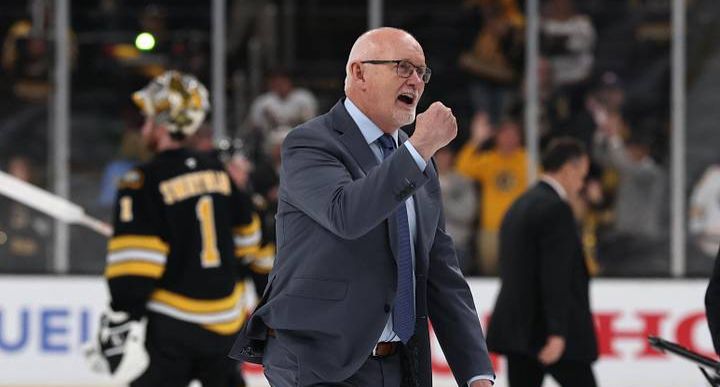
Barry Melrose, the former NHL coach, longtime ESPN hockey analyst and one of the sport’s most recognizable personalities, has died at the age of 70.
Melrose, who had been diagnosed with Parkinson’s disease three years ago, died Wednesday, according to his wife, Cindy. His death was confirmed to ESPN, the network where he spent decades building a reputation as one of hockey’s most outspoken and entertaining analysts.
For generations of hockey fans, Melrose was much more than a coach or television personality. He was known for his toughness, strong opinions, colorful personality and unmistakable appearance. His trademark mullet and flamboyant suits became almost as recognizable as his passionate commentary on the game.
Melrose’s connection to hockey also extended deep into the Toronto Maple Leafs family. He was the first cousin of former Leafs star Wendel Clark. Both men were born in Kelvington, Saskatchewan, and grew up within a close-knit hockey community that produced several notable NHL players.
Their family connection added another intriguing chapter to Melrose’s career, particularly during the 1993 Stanley Cup playoffs.
From Tough Defenseman to NHL Coach
Before making his biggest impact behind the bench and in the broadcast booth, Melrose carved out a reputation as a hard-nosed defenseman.
He was selected by the Montreal Canadiens in the second round of the NHL Draft and eventually played 300 NHL games. His NHL career included stops with the Winnipeg Jets, Toronto Maple Leafs and Detroit Red Wings.
Melrose also spent considerable time in the World Hockey Association, playing 178 games for the Cincinnati Stingers before eventually moving into the NHL.
His playing career reflected the physical style of hockey that was common during his era. Melrose accumulated more than 1,000 minutes in penalties during his professional career, establishing himself as a player who was never afraid of confrontation.
However, it was his transition into coaching that ultimately made him an international hockey figure.
Melrose won a Calder Cup championship while coaching the Adirondack Red Wings, Detroit’s farm team. That success helped earn him the opportunity to coach the Los Angeles Kings, where he inherited a veteran roster featuring superstar Wayne Gretzky.
The 1993 Stanley Cup Run
Melrose immediately made his mark in Los Angeles.
During his first season as the Kings’ head coach, he guided the team through an unforgettable playoff run that took them all the way to the 1993 Stanley Cup Final.
One of the defining moments of that postseason came against the Toronto Maple Leafs.
Los Angeles and Toronto met in a dramatic seven-game conference final, with the Kings eventually eliminating the Leafs. For Toronto, the defeat was particularly painful because the club came within one series of reaching the Stanley Cup Final during a period when championship opportunities had been extremely difficult to find.
The series also featured tension between Melrose and Toronto head coach Pat Burns.
Burns, known for his intensity and physical presence, reportedly became furious after Melrose made comments about his weight. The disagreement escalated to the point where Burns attempted to get past security at Maple Leaf Gardens in an effort to confront the Kings coach.
Toronto general manager Cliff Fletcher later joked about the incident, suggesting that Melrose was fortunate Burns never managed to reach him.
The Kings ultimately advanced to the Stanley Cup Final, although their championship dream ended when the Montreal Canadiens won the series.
Despite reaching hockey’s biggest stage in his first season, Melrose was unable to reproduce that level of postseason success during his subsequent coaching opportunities.
A New Career in Television
While coaching did not ultimately define Melrose’s career, television gave him another platform to influence the sport.
He joined ESPN in 1996 and quickly became one of the network’s most distinctive hockey voices.
Melrose brought the same confidence and directness that had characterized his playing and coaching careers to his television work. He was never afraid to offer strong opinions, challenge conventional thinking or explain the game in an accessible way.
His colorful wardrobe and iconic mullet added to his public image, but it was his understanding of hockey that made him valuable to viewers.
ESPN described Melrose as one of the most distinctive and trusted voices in hockey, praising his deep knowledge, honesty and passion for the sport.
Over the years, he became a familiar presence for American hockey audiences and helped make the game more accessible to viewers who were still developing an interest in the NHL.
His colleagues also remembered him as a warm and loyal friend away from the cameras.
ESPN personality John Buccigross described Melrose as his best friend at the network and compared him to an older brother who consistently demonstrated strong values.
Hockey broadcaster Chris Cuthbert also paid tribute to Melrose, describing him as one of the sport’s most influential and colorful personalities.
Parkinson’s Diagnosis
Melrose’s broadcasting career was interrupted after he revealed that he had been diagnosed with Parkinson’s disease.
The diagnosis eventually led him to step away from ESPN.
Wayne Gretzky, who worked with Melrose during the coach’s memorable years with the Kings, previously offered an emotional tribute when Melrose was forced to leave his broadcasting role.
Gretzky emphasized that Melrose’s importance went far beyond the teams he coached or the games he analyzed. He described him as someone who had become bigger than any individual hockey team.
That sentiment captured the impact Melrose had on the sport over several decades.
He experienced hockey from almost every perspective imaginable: player, coach, analyst, author and passionate ambassador.
A Lasting Hockey Legacy
Melrose also shared his experiences through his book, Dropping the Gloves, which explored the competitive and often demanding world of professional hockey.
His legacy extended beyond his statistics or coaching record. He became part of the culture surrounding hockey, particularly through his ability to make discussions about the sport entertaining.
NHL commissioner Gary Bettman was among those who recognized Melrose’s influence.
In a league statement, Bettman highlighted the unmistakable image Melrose created through his flowing mullet and distinctive long sports coats. But behind the memorable appearance was someone whose understanding of hockey allowed him to connect with fans across generations.
Melrose’s death marks the end of a remarkable career that spanned multiple eras of professional hockey.
He played during the rough-and-tumble days of the WHA and NHL, coached a team led by Gretzky to the Stanley Cup Final, and later became one of the most familiar hockey analysts on American television.
His relationship with Wendel Clark also gave him a unique connection to the Maple Leafs, even when the two found themselves on opposite sides of one of the most memorable playoff battles of the early 1990s.
For hockey fans, Barry Melrose will be remembered not simply for his coaching achievements or his television work, but for the personality he brought to everything he did.
He was outspoken, competitive, entertaining and unapologetically himself.
ESPN said his passion for hockey was unmistakable and that he always found a way to keep the game interesting.
That may ultimately be one of the strongest descriptions of Melrose’s legacy. Whether he was standing behind an NHL bench, analyzing a game on television or talking about the sport away from the rink, he had a way of making people pay attention.
Barry Melrose leaves behind a lasting place in hockey history, remembered by former teammates, players, coaches, broadcasters and fans who watched him make an unmistakable impact on the sport he loved.