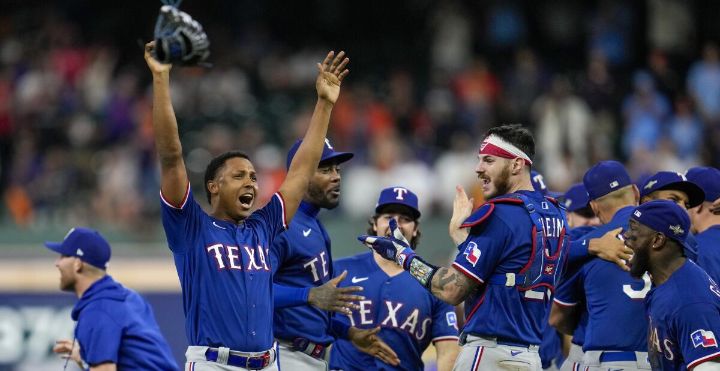
With the MLB trade deadline approaching on Aug. 3, the Texas Rangers face a critical decision that could shape both their playoff hopes and their long-term future. While the front office is expected to explore upgrades to strengthen the major league roster, it must also decide how much of its farm system it is willing to sacrifice to acquire immediate help.
Unlike the aggressive push that culminated in a World Series championship a few years ago, the Rangers are working from a different position this season. Their minor league system still features promising talent, but it lacks the same level of elite depth that previously enabled Texas to acquire established stars such as Max Scherzer, Jordan Montgomery, and Aroldis Chapman without completely emptying the pipeline.
If Texas decides to pursue another significant trade, prospects will almost certainly become part of negotiations. However, not every young player should be considered expendable. Several prospects represent foundational pieces of the franchise’s future and should remain off limits regardless of the offers that arrive before the deadline.
Here are five Rangers prospects who should stay in the organization.
Sebastian Walcott
Sebastian Walcott remains the crown jewel of the Rangers’ farm system. Ranked as the organization’s top prospect and widely viewed as one of baseball’s elite young talents, he possesses the type of upside that organizations rarely consider moving.
Although elite prospects occasionally become trade chips when a team believes it is one player away from winning a championship, the Rangers are not currently in that position. Their roster has multiple areas that require improvement, making it difficult to justify parting with a player who could become one of the franchise’s future stars.
Walcott has already overcome internal brace surgery and returned to Double-A Frisco. During his rehabilitation, he added strength to his frame, potentially increasing his future power at the plate. Scouts believe his offensive ceiling may now be even higher than before the injury.
His continued development suggests he could reach the major leagues as early as next season. A player with that combination of athleticism, power potential, and long-term value should remain untouchable.
Caden Scarborough
The Rangers have already paid a significant price for pitching help in recent seasons by dealing several highly regarded pitching prospects. Repeating that strategy this year could leave the organization dangerously thin on young arms.
Caden Scarborough has emerged as one of the most important pitchers in the Rangers’ development system. After climbing prospect rankings quickly over the past year, he has established himself as one of the organization’s premier pitching prospects.
His current statistics do not fully reflect his ability. Injuries interrupted his season, and the resulting inconsistency has affected his overall numbers. Even so, evaluators continue to view him as one of the club’s most promising young starters.
His previous campaign offered a much clearer picture of his potential, as he consistently demonstrated command, swing-and-miss ability, and poise beyond his years.
Developing quality starting pitching internally remains one of the most valuable assets any organization can possess. Given Scarborough’s upside, the Rangers would be wise to keep him rather than using him as trade capital.
Seong-Jun Kim
One of the most fascinating prospects in the Rangers’ system is Korean teenager Seong-Jun Kim, whose versatility makes him especially valuable.
Kim is developing as both a shortstop and a pitcher, giving Texas the opportunity to evaluate him as a true two-way player. While the organization also has another two-way talent in Josh Owens, Kim appears to be progressing slightly faster at this stage of his career.
Before signing with Texas, Kim was projected to become a first-round selection in the Korea Baseball Organization draft. Instead, he chose to begin his professional career in the Rangers organization.
Currently playing in the Arizona Complex League, the 19-year-old has impressed on both sides of the game. At the plate, he has shown the ability to consistently reach base while producing quality contact. On the mound, he has demonstrated excellent control and maturity, posting impressive numbers in limited appearances.
The Rangers are carefully managing his workload to allow steady development without overtaxing either aspect of his game.
Because players with legitimate two-way potential are extremely rare, Kim could attract significant interest from rival organizations. Nevertheless, his unique skill set gives the Rangers an opportunity to develop a player capable of contributing in multiple ways, making him far too valuable to include in trade discussions.
Dalton Pence
Left-handed pitching has become one of the most coveted commodities throughout Major League Baseball, making Dalton Pence an especially important piece of the Rangers’ future.
Pence already turned heads during major league spring training after receiving a non-roster invitation. His performance impressed both the coaching staff and manager Skip Schumacher, reinforcing the organization’s belief in his long-term potential.
The Rangers also understand how valuable quality left-handed starters can become. After trading away multiple left-handed pitching prospects in previous deals, rebuilding that depth has become increasingly important.
Pence offers one of the best opportunities to replenish that pipeline.
Throughout the season, he has continued to show encouraging progress, combining strikeout ability with consistent command. His strong performance earned him a promotion to Double-A Frisco, where he now faces more advanced competition as he continues climbing toward the major leagues.
If his development stays on course, Pence could become an important member of Texas’ pitching staff within the next couple of seasons. Trading away a controllable, homegrown left-hander before he reaches that point would be difficult to justify.
Dylan Dreiling
Outfielder Dylan Dreiling has quietly become one of the biggest success stories in the Rangers’ farm system this season.
The former Tennessee standout has taken significant strides offensively, producing one of the strongest campaigns of his professional career. His combination of batting average, on-base ability, power, and run production has made him one of the most productive hitters at Double-A Frisco.
His consistent offensive improvement has positioned him for a likely promotion to Triple-A Round Rock, placing him only one step away from the major leagues.
Because several contenders are searching for outfield help before the trade deadline, Dreiling could become an attractive target in negotiations. However, Texas has compelling reasons to hold onto him.
While Wyatt Langford and Brandon Nimmo remain important pieces of the Rangers’ outfield plans, uncertainty surrounding Evan Carter’s development could create additional opportunities in the near future. If Carter continues to struggle or injuries create openings, Dreiling may be ready to compete for playing time much sooner than expected.
Given his current trajectory, he could realistically make his major league debut sometime during the 2027 season and develop into a regular contributor.
Rangers Must Balance Present and Future
The Rangers undoubtedly want to improve their roster before the trade deadline, particularly if they remain in postseason contention. Acquiring experienced major league talent could strengthen their chances of competing this year, but those moves should not come at the expense of the organization’s brightest young players.
Sebastian Walcott projects as a future cornerstone, Caden Scarborough could anchor the starting rotation, Seong-Jun Kim offers rare two-way potential, Dalton Pence fills a vital need for left-handed pitching, and Dylan Dreiling continues to emerge as a possible long-term answer in the outfield.
While other prospects could become trade chips in the right deal, these five represent the type of foundational talent successful organizations build around. Protecting them would allow the Rangers to pursue both short-term competitiveness and sustained success for years to come.