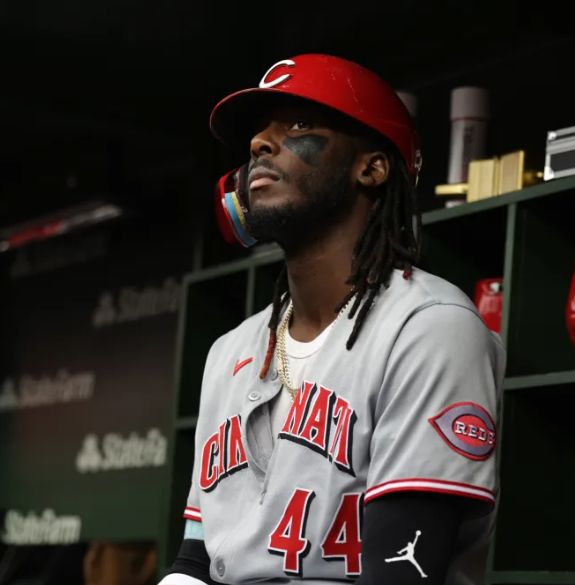
In the intricate and often speculative world of baseball prospecting, where future stars are glimpsed in the raw skills of teenagers, a new name has surged into the consciousness of keen Philadelphia Phillies followers. Romeli Espinosa, a 17-year-old shortstop who spent 2025 in the Dominican Summer League (DSL), is not yet a household name. However, a recent and aggressive ranking from the respected analysts at FanGraphs has placed a spotlight on him, complete with a tantalizing—if wildly optimistic—comparison to one of baseball’s most electrifying young talents: Cincinnati Reds shortstop Elly De La Cruz.
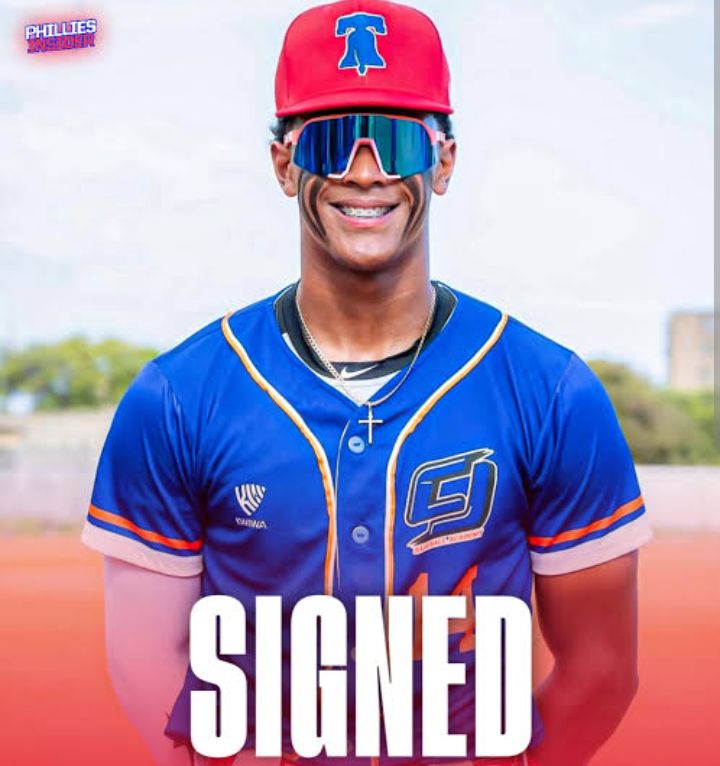
The prospect landscape for the Phillies is traditionally headlined by familiar, high-ceiling names like Aidan Miller, Andrew Painter, and Justin Crawford. Yet, in FanGraphs’ latest organizational ranking, which lists 34 Phillies prospects, a mysterious entry appears at the notable position of number 11: Romeli Espinosa. The ranking itself comes with a caveat, described as “aggressive” and explicitly intended to “illustrate his ceiling.” This is not a declaration of a finished product or a guaranteed superstar, but rather a flag planted on a distant hill, marking a player whose physical tools and early performance suggest a trajectory far steeper than his current placement in the low minors would typically indicate.
The heart of the buzz lies in the physical comparison. FanGraphs analysts note that Espinosa, at just 17 years old, presents “a rare combination of present contact feel and long-term power projection for an up-the-middle prospect.” The report then delves into the De La Cruz comp, stating: “Espinosa’s build comps to Elly De La Cruz at the same age: endless limbs on a broad-shouldered 6-foot-4 frame, with the room to add big strength while remaining sufficiently lithe and agile for shortstop.” This is the archetype of the modern baseball unicorn: a player with the tall, long-levered build that generates immense raw power, coupled with the athleticism and coordination to potentially remain at the demanding defensive position of shortstop. De La Cruz himself embodies this dream, combining 30-home run power with elite speed and arm strength from the shortstop position. To see even a whisper of that physical prototype in a Phillies prospect is undeniably intriguing.
Beyond the physique, Espinosa’s first professional season provides statistical reasons for optimism. In 41 games in the DSL, he slashed .282/.363/.430. The components of that line are telling. His five triples and two home runs hint at the extra-base power and speed that comes with his frame. Stealing 12 bases underscores his current athleticism. However, the most promising sign for a player of his size and age is his demonstrated bat-to-ball skill. In 168 plate appearances, Espinosa struck out only 34 times. For a tall, young hitter whose limbs are still growing into his body, this level of contact is exceptional.
FanGraphs emphasizes this point, writing: “That’s a very positive contact-hitting origin point for a shortstop prospect built like this, as long-levered hitters like Espinosa are often still uncoordinated at this age.” Typically, players with such projectable power struggle mightily with contact in their early teens, as they learn to manage their expanding strike zones and longer swings. That Espinosa has shown an ability to put the bat on the ball consistently, while also showing glimpses of power, forms the core of his early appeal. It suggests a foundational hitting ability upon which strength and power can be built, rather than a player who must completely overhaul his swing to make contact at higher levels.
Espinosa’s journey to this point began when he signed with the Phillies as an international free agent on January 15, 2025, for a bonus of $250,000. He did not even turn 17 until that June, making his 2025 DSL performance all the more impressive for his youth relative to the league. His career is now poised for its next, critical phase: the transition to the United States. For the 2026 season, he is expected to head stateside to compete in the Florida Complex League (FCL).
This promotion represents a significant jump in competition. The FCL, while still rookie-level, features more polished pitching, including recent draftees from the U.S. college and high school ranks. Espinosa will be one of the youngest hitters in the league, and the challenges will be multifaceted. He will face pitchers with more advanced arsenals and command, all while adapting to a new culture and environment. This is where the “aggressive” ranking will truly be tested. Can his contact skills hold up against better velocity and breaking balls? Will his body continue to develop as projected, adding the strength needed to turn his doubles and triples into home runs as he climbs the ladder?
It is crucial to temper expectations with a heavy dose of reality. The distance between the DSL/FCL and Major League stardom is a marathon, not a sprint. For every Elly De La Cruz, there are countless prospects with similar physical gifts who never master the hit tool, whose bodies outgrow shortstop, or who are derailed by injury. The comparison to De La Cruz is less a prediction and more an illustration of a style of potential—a ceiling of dynamic, tool-shed excellence that is the rarest of commodities in baseball. The likelihood of Espinosa reaching that zenith is minimal, as it is for any prospect. The more practical hope is that he develops into a valuable, everyday Major League player, with his ultimate position (shortstop, third base, or an outfield corner) determined by his physical development and defensive refinement.
For the Phillies’ player development staff, Espinosa represents an exciting project. The blueprint is clear: nurture the hit tool, gradually unlock the in-game power through strength and conditioning, and diligently work to maintain his defensive agility. His progression will be one of the more fascinating storylines to follow in the lower minors over the next few seasons.

In conclusion, the emergence of Romeli Espinosa on prospect rankings is a classic tale of baseball’s future promise. It is a story built on a compelling physical comparison, encouraging early data, and the expert projection of industry analysts. While the Elly De La Cruz comp is a headline-grabber meant to contextualize his ceiling, the real story is the arrival of a uniquely gifted 17-year-old in the Phillies’ system who possesses the foundational skills—notably contact ability—to potentially capitalize on his enormous physical gifts. His upcoming debut in the Florida Complex League will be the first major test of whether this early hype is merely a tantalizing daydream or the first chapter in the rise of Philadelphia’s next homegrown star. The dream is now officially alive, waiting to be tempered or fulfilled by the unforgiving and illuminating game of baseball itself.