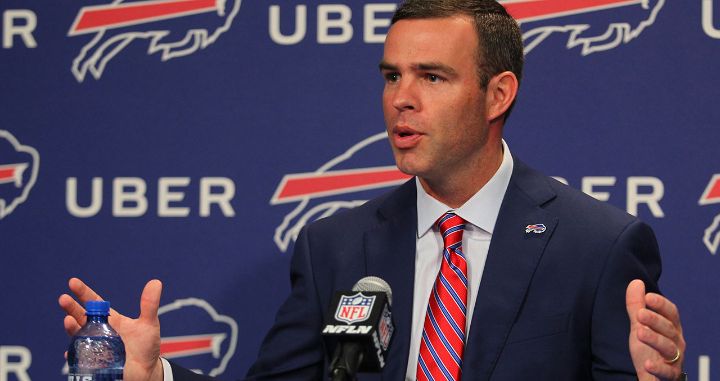
In the high-stakes, salary-cap-constrained world of the NFL, the decisions made in the spring often echo loudly into the winter. While free agency grabs the headlines and the draft captures the imagination, the mundane administrative task of exercising a fifth-year option on a rookie contract is a significant declaration of a franchise’s long-term faith in a player. For the Buffalo Bills, that declaration was made official this week, not with a press conference, but through a casual confirmation from General Manager Brandon Beane on the team’s flagship radio show, One Bills Live.
When Beane stated that the team would pick up the fifth-year option for tight end Dalton Kincaid “at the right time” this spring, it was more than just a procedural box-checking exercise. It was a public reaffirmation that the former first-round pick from Utah is viewed not merely as a complementary piece, but as a foundational pillar of an offense undergoing a significant philosophical transition.
To understand the weight of this decision, one must look back at the trajectory of the Bills’ offense over the past 18 months. For the better part of four seasons, the aerial attack was defined by the breathtaking, improvisational connection between quarterback Josh Allen and wide receiver Stefon Diggs. Diggs was the alpha, the volume target, the engine that dictated coverages and demanded double-teams. However, the business of football is rarely static. The 2023 season brought with it a palpable tension, culminating in the pre-draft trade that sent Diggs to the Houston Texans. This move, coupled with the departure of key veteran slot receiver Gabe Davis in free agency, left a void of over 200 targets in the Bills’ passing game.
Enter Dalton Kincaid.
Selected 25th overall in the 2023 NFL Draft, Kincaid was initially viewed as a luxurious “chess piece”—a move tight end who could create mismatches against linebackers and safeties. His rookie season was a masterclass in integration, as he caught 73 passes for 673 yards and two touchdowns, often operating underneath the deep clear-outs provided by Diggs and Davis. But the 2024 season told a different story. With Diggs gone, the burden of being the focal point of the passing attack shifted, and defenses began to game-plan specifically for Kincaid.
His second season was a study in the difference between production and impact. While his raw numbers dipped slightly—a common occurrence for a tight end facing the league’s adjusted defensive schemes after a promising rookie year—his role in the offense evolved. He became the security blanket that offensive coordinator Joe Brady craved. In critical third-down situations and in the red zone, the ball increasingly found its way to number 86. Though his touchdown totals remained modest, his ability to move the chains and occupy the intermediate middle of the field became the glue that held the rebuilt receiving corps together. He provided a reliable outlet for Allen, a quarterback who thrives on extending plays, knowing his big-bodied tight end could find a soft spot in the zone coverage.
By exercising the fifth-year option, Beane is effectively betting that Kincaid’s second-year “stagnation” was actually the necessary growing pains of becoming a primary weapon. The option, a mechanism built into every first-round contract, guarantees Kincaid a substantial, fully guaranteed salary for the 2027 season. The exact value will be calculated based on a formula that accounts for playing time and performance, but for a player selected in the middle of the first round, it projects to be a significant financial commitment. This move buys the Bills two more years of team control (2026, the final year of his rookie deal, and 2027, the option year) to evaluate whether he can truly ascend to the “elite” tier of NFL tight ends, a group that commands salaries north of $15 million per year.
This decision is inextricably linked to the team’s broader roster construction. The Bills have been notoriously aggressive in pushing their championship window open, often utilizing voidable years and restructures to keep the core together. However, the departure of Diggs’ contract signaled a subtle shift toward a more sustainable, balanced model. In this new era, the passing game will be defined by distribution rather than concentration. While rookie wide receivers Keon Coleman and second-year man Khalil Shakir will be counted on to provide explosive plays on the perimeter and from the slot, respectively, it is Kincaid who will be tasked with being the steadying influence.
The modern NFL tight end is asked to be a hybrid: a capable in-line blocker, a seam-stretching receiver, and a chain-moving safety valve. Kincaid’s skill set leans heavily toward the receiving aspect, a trait Beane and head coach Sean McDermott have consistently valued. In a conference now loaded with dynamic young quarterbacks and high-powered offenses, having a tight end who can consistently win one-on-one matchups is a competitive advantage. By picking up this option now, the Bills are signaling that they believe Kincaid is that player.
There is also a psychological component to the move. By securing Kincaid’s financial future (at least for the next two years) well before the start of the 2025 season, the organization removes a potential distraction. Kincaid can now enter a pivotal third year—often the season where players make the leap to stardom—with the full faith of his general manager and coaching staff. He knows he is not playing for a contract; he is playing for a legacy and a potential long-term extension that would keep him in Buffalo for the better part of a decade.
In the landscape of the NFL, a fifth-year option is not a lifetime achievement award. It is a calculated risk based on potential. Brandon Beane, known for his shrewd roster management, is looking at a 24-year-old tight end who has already demonstrated the ability to be a productive NFL player. He is betting that with another offseason of refinement, a clearer offensive identity, and a continued strong bond with a franchise quarterback, Kincaid will evolve from a “good” player into a “great” one.
The “right time” Beane alluded to on One Bills Live is not just a procedural deadline this spring. It is a reflection of the Bills’ belief that the right time for Dalton Kincaid to become the centerpiece of their passing attack is now. The financial paperwork will be filed, the option will be exercised, and the Bills will move forward, hoping that their investment in the reliable hands of their young tight end will be the key to unlocking the final piece of their Super Bowl puzzle.