In the annals of music history, few stories are as dramatic, inspiring, and downright unbelievable as that of Julio Iglesias. We know him today as the debonair, tuxedo-clad icon who has serenaded hundreds of millions of fans across the globe. He is the personification of romance, the man with the velvet voice who has sold over 300 million records in 14 languages. But behind the glittering career and the Hollywood Walk of Fame star lies a origin story so harrowing that it defies belief—a story that began not in a recording studio, but in a hospital bed, surrounded by doctors who offered no hope.
If you think you know Julio Iglesias, think again. The real story of how he got here is one of impossible odds, a single guitar, and a resilience that would eventually conquer the world.
It was a crisp autumn night in Madrid, 1963. A 19-year-old Julio was a young man with a singular, burning passion: football. A promising goalkeeper in the youth ranks of Real Madrid, one of the most prestigious football clubs in the world, he lived and breathed the sport. His future seemed pre-written. He was on the path to professional glory, training tirelessly with dreams of guarding the net at the Santiago Bernabéu Stadium. Life was a straight line toward athletic stardom.
Then, in a split second, everything changed.
In the early hours of September 22, 1963, Julio and his friends were heading home from a party. Driving a reconditioned Ford Thunderbird, Julio lost control of the vehicle on a curve just outside Madrid. The car flipped several times, crashing violently. His two friends escaped with minor injuries. Julio was not so lucky. He was thrown from the vehicle, and the impact shattered his lower body.
Rushed to the hospital, the young athlete was in a catastrophic state. The diagnosis was a nightmare. His spinal column was damaged, his legs were crushed, and his lower body was virtually paralyzed. He was conscious, he was alert, but he couldn’t feel his legs. For a 19-year-old whose entire identity was built on physical prowess and athletic ability, the news was a psychological gut punch far worse than the physical pain.
But the worst was yet to come.
The doctors were blunt. They sat down with his devastated parents and delivered the verdict with clinical coldness: Julio would likely never walk again. If, by some miracle, he did manage to stand, he would be a paraplegic for life, confined to a wheelchair, his body broken beyond full repair. The dream of Real Madrid, of professional football, was not just delayed—it was incinerated. The straight line he had been walking on had vanished into a dark abyss.
For a year and a half, Julio Iglesias disappeared from the world.
That is how long he remained immobilized in the hospital and later confined to his bed at home. He was trapped in a body that refused to obey his commands. He went through countless surgeries, painful rehabilitation sessions, and the slow, grinding process of relearning how to move a toe, how to flex a muscle. He was a prisoner, and the silence was deafening.
It was in that silence that the music found him.
During his long convalescence, a young nurse at the hospital—a woman whose name history has largely forgotten but to whom the music world owes an unpayable debt—handed Julio a guitar. It was a simple, almost naive gesture. She thought it might help him pass the time, to exercise his hands and fingers, to give him something to focus on besides the pain and the uncertainty.
Julio had never played the guitar before. He didn’t know chords. He didn’t know strumming patterns. But he had time. He had nothing but time.
Lying in his hospital bed, he began to teach himself. He would listen to the radio and try to pick out the melodies. He started writing little poems, little thoughts, and setting them to the simple chords he was slowly learning. The guitar became his crutch, his wheelchair, and eventually, his legs. It gave him a voice when his body had failed him.
He later recalled that the guitar was his therapy, his escape from the “intolerable reality” of his situation. It wasn’t ambition that drove him; it was survival. He needed something to hold onto, and the neck of that guitar became his lifeline.
Miraculously, slowly, agonizingly, Julio began to walk again.
Defying every prognosis, every grim prediction, he fought his way back to his feet. It wasn’t a full recovery—he still deals with the consequences of that accident to this day, and it is why audiences rarely see him walking extensively on stage without support—but he walked. He proved the doctors wrong. The body that was supposed to be broken forever carried him into a new life.
But the question remained: What now? He couldn’t play football. The straight line was gone. The only thing he had was that guitar and a collection of songs he had written in the dark.
Encouraged by friends who heard him strumming at parties, Julio decided to enter a local songwriting competition. Then another. In 1968, five years after the accident that was supposed to end his life, he stood on stage at the prestigious Benidorm International Song Festival. He sang a song he had written, a ballad called “La vida sigue igual” (Life Goes On the Same).
The irony of the title was not lost on him. Life hadn’t gone on the same at all. It had been shattered and rebuilt. But the sentiment resonated. He won the festival, securing a recording contract that would change the world.
From that hospital bed where he was told he would never walk, Julio Iglesias went on to become the best-selling Latin artist in the history of music. He has performed for popes, presidents, and royalty. He has duetted with legends like Willie Nelson, Frank Sinatra, and Diana Ross. He has a star on the Hollywood Walk of Fame, a Grammy Lifetime Achievement Award, and a legacy that spans every continent.
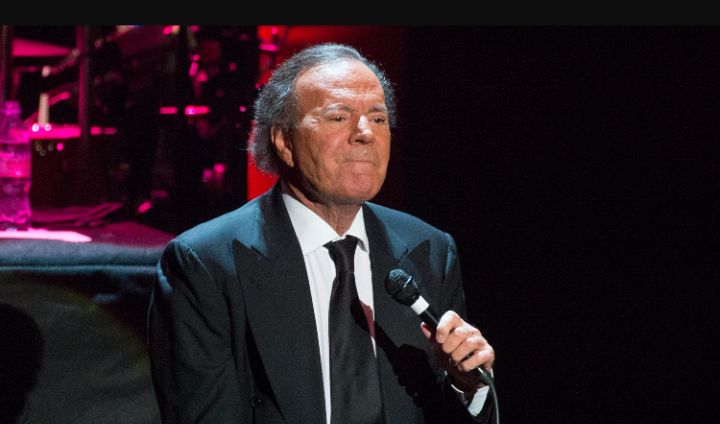
And now, here he is, decades later, doing THIS.
At an age when most people are content to rest, Julio Iglesias continues to captivate audiences. The man who was told he would never walk is not only walking—he is headlining tours, selling out arenas, and reminding the world why his voice became the soundtrack of millions of romances.
His story is the ultimate testament to the power of the human spirit. It tells us that sometimes, the greatest successes are born from the deepest valleys. A tragic car crash shattered a footballer’s dream, but it inadvertently gave the world one of its greatest singers.
So, the next time you see Julio Iglesias smile on stage, remember: that smile was hard-earned. It was forged in a hospital room, built one painful step at a time, and strummed into existence on a guitar given to him by a kind nurse who probably had no idea she was handing a legend his future.
Doctors said he’d never walk again. Now, he’s taking the world by storm, one timeless song at a time.