
For the better part of a decade, the blueprint for October glory has been written with relief pitching. The starting pitcher sets the table, but it’s the battalion of power arms in the bullpen that often determines whether a team gets to eat. The Philadelphia Phillies, after consecutive years of falling just short of their ultimate goal, have taken this lesson to heart. Entering the 2026 season, they are not just building a bullpen; they are assembling a diverse, multifaceted unit designed to neutralize modern lineups in a way their previous iterations could not.
The foundation of this new-look relief corps was laid this past offseason. The front office, led by Dave Dombrowski, was proactive, most notably signing veteran right-hander Brad Keller to a two-year, $22 million contract to add a stable, ground-ball-inducing presence. But perhaps the most pivotal move for the bullpen’s final construction was a subtraction: the trade of left-handed pitcher Matt Strahm to the Kansas City Royals.
Shipping Strahm to Kansas City opened up a spot on the roster and in the bullpen hierarchy. It was a calculated decision, a bet that the sum of the parts could be greater than the individual. While the trade brought back young pitcher Jonathan Bowlan—another arm expected to contribute in relief—the most intriguing consequence has been the clear pathway created for a pitcher who wasn’t even on the roster at the time of the deal: Kyle Backhus.
Acquired just a few months ago, Backhus is quickly becoming one of the most compelling stories of Phillies spring training. In a bullpen already stocked with hard-throwers, Backhus doesn’t fit the mold of a typical reliever. He doesn’t need to. His ticket to high-leverage situations is stamped with a delivery so unique it threatens to disrupt the very physics of a hitter’s timing.
According to data from MLB.com’s Todd Zelecki, Backhus registered the fourth-lowest average arm angle in all of Major League Baseball last season, releasing the ball at a subterranean nine degrees. For context, that’s almost sidearm, a trajectory that starts near the dirt and climbs towards the zone. This isn’t just a statistical curiosity; it’s a strategic weapon. In an era where hitters train against high-velocity, high-spin four-seamers thrown from over-the-top slots, Backhus offers a disorienting contrast.
The Phillies’ bullpen is now built on the principle of contrast. When manager Rob Thomson looks to the left side, he can now deploy a triple threat that looks nothing alike. First, there’s Jose Alvarado, whose 59-degree arm angle and triple-digit velocity create a steep, intimidating downhill plane. Then there’s Tanner Banks, another lefty with a more conventional high slot. And finally, there’s Backhus, entering the game with an arm angle so low it’s almost horizontal. A hitter facing Alvarado one inning and Backhus the next isn’t just facing a different pitcher; they are facing a different geometrical problem. The eye level, the perceived release point, and the break of the ball are all fundamentally altered, making it incredibly difficult to establish a consistent rhythm or timing mechanism.
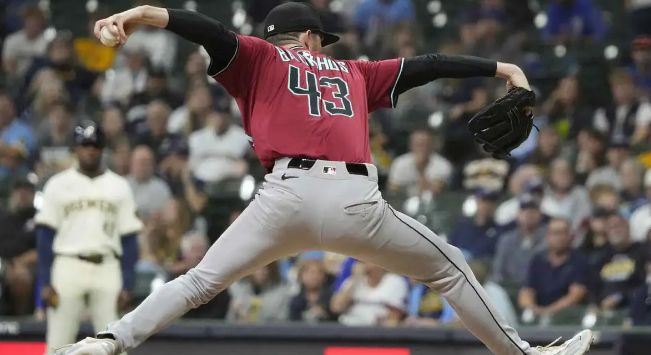
Backhus’ emergence as this “change-of-pace” weapon is a testament to the Phillies’ front-office vision. They didn’t just seek out talent; they sought out specific, outlier skills that could be leveraged in the chess match of a playoff series. In a seven-game series, familiarity breeds success for hitters. By assembling a bullpen with extreme variance—from Duran’s triple-digit heat to Kerkering’s sweeper to Backhus’ low-slung deliveries—the Phillies are betting they can keep even the most potent lineups off-balance.
The rest of the bullpen picture is coming into sharp focus. The closer role is cemented by Jhoan Duran, whose 100+ mph “splinker” is arguably the single most unhittable pitch in baseball. He provides the hammer at the back end. Ahead of him, the aforementioned group of Keller, Alvarado, Banks, Kerkering, and Bowlan forms a deep and versatile bridge. Kerkering, in particular, is a bounce-back candidate to watch. After a sensational rookie campaign, he hit a wall late in the 2025 season, culminating in a heartbreaking postseason performance that has fueled his offseason work. His sharp, sweeper-heavy arsenal is expected to be a key component of the setup crew.
But it is Backhus who represents the X-factor. He is the bullpen arm that opposing teams can’t prepare for because they simply don’t see anything like him on a regular basis. His role may not be defined by the inning he pitches, but by the matchup he creates. He could be deployed as a lefty specialist, a multi-inning bridge, or simply as a “disrupter” brought in to break a opponent’s offensive momentum.
The Phillies’ approach to the 2026 season is clear. They believe their starting rotation, headlined by Aaron Nola and Zack Wheeler, is good enough to get them to the late innings with a lead. From there, they have constructed a relief unit with no obvious soft spot, a collection of arms that features power, finesse, and now, with Backhus, an element of the truly bizarre. The Matt Strahm trade may have initially looked like a simple salary or roster maneuver, but its ripple effect has helped the Phillies uncover a potential unicorn—a pitcher whose unique arm angle could be the final, unexpected piece in their pursuit of a World Championship.