In the relentless, 24/7 news cycle of the National Football League, even a seemingly minor transaction can offer a revealing glimpse into a team’s philosophy, its roster-building strategy, and its long-term vision. Such is the case with the recent move by the Buffalo Bills to retain the services of offensive lineman Alec Anderson. According to a report from NFL insider Ian Rapoport, the Bills have secured Anderson on a new one-year contract. The deal is reportedly worth a total of $3 million, a significant portion of which—$1.8 million to be precise—is fully guaranteed.
At first glance, the re-signing of a little-known offensive lineman to a modest one-year deal might appear to be a footnote in the flurry of offseason activity that grips the NFL each year. However, a deeper dive into the specifics of the contract and the player’s journey to this point reveals a story of player development, organizational trust, and the critical importance of squad depth in a sport defined by its physical brutality. This move is not just about keeping a player on the roster; it is an investment in continuity, a reward for internal growth, and a strategic decision that reinforces the foundation of the team.
A Deep Dive into the Financial Commitment
The financial terms of the agreement are particularly telling. The total value of $3 million places Anderson firmly in the range of a proven rotational player or a core special teamer, a significant step up from the minimum-salary benefit contracts typically offered to players on the fringes of the roster. However, the most crucial figure in this report is the $1.8 million in guaranteed money.
In the NFL, guarantees are the ultimate currency of trust. They represent a team’s tangible commitment to a player, signaling that they envision him not just competing for a spot during the grueling days of training camp, but occupying a defined role on the 53-man roster come September. By guaranteeing well over half of the contract’s value, the Bills are effectively ensuring Anderson’s place in their immediate plans. This level of guarantee makes it financially prohibitive to simply release him before the season starts, suggesting the team views him as a reliable piece of their offensive line puzzle.
This guaranteed sum also serves as a powerful motivator and a sign of organizational respect. For a player who entered the league as an undrafted free agent—a path Anderson took in 2022—earning this kind of financial security is a monumental achievement. It validates years of unseen effort in practice squads, film study, and special teams drills. It tells Anderson that the coaching staff and front office believe in his trajectory and are willing to invest in his future as a Buffalo Bill.
Understanding the Player: Alec Anderson’s Journey
Alec Anderson’s path to this moment is a classic tale of NFL perseverance. After going unselected in the 2022 NFL Draft, he had to prove his worth the hard way. He spent his rookie season navigating the precarious life of a practice squad player, learning the playbook, absorbing the coaching, and biding his time. His role began to expand in 2023, and by 2024, he had carved out a niche for himself as a valuable backup and a core contributor on special teams.
Standing at 6’5″ and possessing a powerful frame, Anderson’s appeal lies in his versatility along the offensive front. During his time in Buffalo, he has taken reps at both guard and tackle positions. This positional flexibility is an invaluable asset in the modern NFL, where a single injury on game day can necessitate a reshuffling of the entire line. A player like Anderson, who can step into multiple spots without the offense missing a beat, is a luxury that offensive line coaches and general managers covet. He provides a crucial insurance policy, allowing the team to keep only seven or eight active linemen on game day, confident that one of them can handle responsibilities at multiple positions if disaster strikes.
The Strategic Importance for the Buffalo Bills
For the Buffalo Bills, a team with perennial Super Bowl aspirations, the decision to re-sign Anderson is a microcosm of their larger team-building philosophy. General Manager Brandon Beane and Head Coach Sean McDermott have consistently prioritized building through the trenches and developing homegrown talent. Investing in a player like Anderson, who has developed within their system, is a direct application of that philosophy.
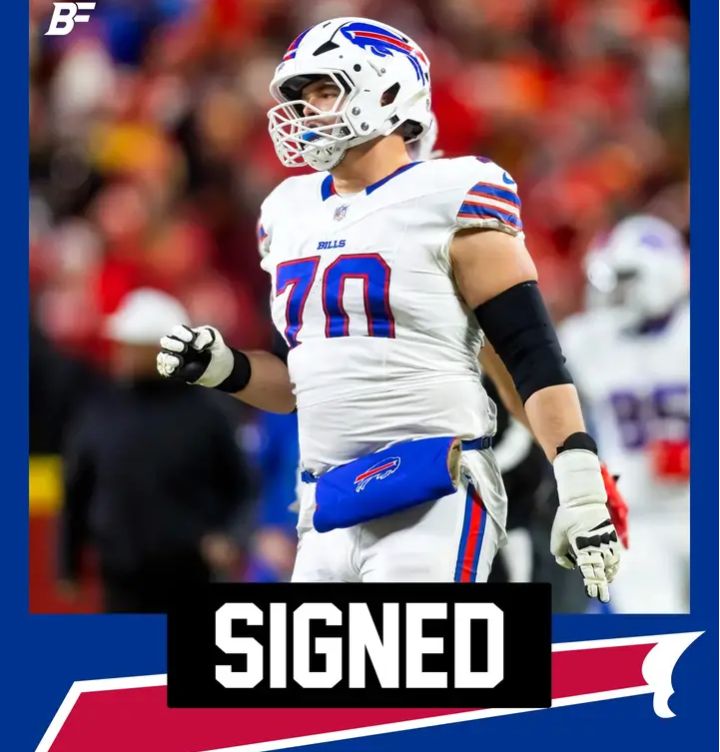
By securing Anderson, the Bills are maintaining continuity along their offensive line. Continuity is paramount for offensive line success, as it breeds familiarity, trust, and cohesion among the five starters and the key reserves. Anderson already knows the scheme, the terminology, the quarterback’s cadence, and the coaches’ expectations. Bringing him back eliminates the need to find and teach a similar player from scratch, saving valuable time during the offseason program and training camp.
Furthermore, this move solidifies the team’s depth chart. Behind a projected starting lineup that includes franchise cornerstones like Dion Dawkins and rising stars, Anderson provides a dependable and experienced backup. His presence ensures that if a starter goes down with an injury—an almost certain inevitability over the course of a 17-game season—the drop-off in performance can be mitigated. He is not just a warm body; he is a player the coaching staff trusts to execute the game plan.
Finally, the $3 million price tag is a savvy piece of salary cap management. In a league with a hard salary cap, finding high-value players at reasonable costs is the key to sustaining success. For the price of a mid-level veteran free agent, the Bills are retaining a young, ascending player who already knows their system. This financial efficiency allows the team to allocate its significant resources to other areas of need, whether that be re-signing their own star players or pursuing impact players in free agency.
Potential Impact and Looking Ahead
As Alec Anderson prepares to sign this new deal, his role with the team is poised for potential expansion. While he may not be challenging for a starting job immediately, his path to the field is clear. He will enter training camp as the front-runner for the primary swing tackle or primary interior backup role, depending on how the depth chart shakes out. His ability to play both on the edge and inside makes him the most logical candidate to be the team’s “sixth man” along the offensive line—the first player off the bench in case of an injury to any of the five starters.
Moreover, his value on special teams cannot be overstated. Many big offensive linemen find a long career as core special teams players, using their size and strength to block on punt and kick return units. Anderson has already proven his worth in this phase of the game, and his new contract solidifies his role as a key special teams contributor.
In conclusion, the Buffalo Bills’ decision to re-sign Alec Anderson to a one-year, $3 million deal with $1.8 million guaranteed is a textbook example of sound NFL roster management. It is a move that rewards internal development, secures crucial depth, maintains scheme continuity, and manages the salary cap effectively. While the signing may not generate the same headlines as a blockbuster trade or a big-name free agent acquisition, its impact will be felt throughout the season. In the grueling war of attrition that is an NFL campaign, having reliable, versatile, and trusted players like Alec Anderson ready to step in can be the difference between a Super Bowl run and a season derailed by injuries. For the Bills, this is more than just a contract; it’s an investment in the foundational depth required to compete for a championship.