For three straight offseasons, Buffalo Bills fans have screamed the same question into the void of social media, talk radio, and the frozen wind of Highmark Stadium: Why won’t you get Josh Allen a true No. 1 wide receiver?
After the departure of Stefon Diggs, the arrival of Mack Hollins, Curtis Samuel, and rookie Keon Coleman felt less like a reload and more like handing a race car driver a spare tire and wishing him luck. When other contenders—from the 49ers to the Eagles to the Chiefs—aggressively traded for elite pass-catchers, Brandon Beane sat on his hands. The trade deadline came and went. No Davante Adams. No Tee Higgins. No Brandon Aiyuk.
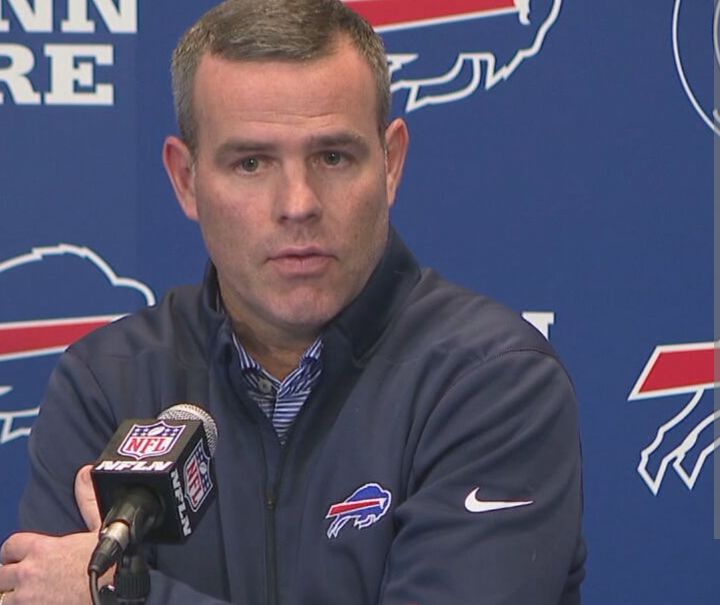
Last week, at his end-of-season press conference, Beane finally addressed the elephant in the room. And Bills Mafia? You are not going to like what he said.
“We Liked Our Room”
The moment that sent fans through the roof came early in the Q&A. A reporter asked directly: “With multiple wide receiver trades available before the deadline, why didn’t you acquire a proven WR1?”
Beane paused, adjusted the microphone, and delivered the line that is now being printed on protest T-shirts outside the stadium.
“We genuinely liked the room we had,” he said. “We felt that with Josh’s ability to elevate, and the young guys developing, we didn’t need to force a big-money rental. That’s not how we’re built.”
The room he liked: a rookie (Coleman), a gadget player (Samuel), a special-teamer (Hollins), and Khalil Shakir—a wonderful slot receiver but not a defense-altering outside threat. By season’s end, the Bills ranked 19th in passing offense, and in the playoff loss to the Chiefs, Allen’s receivers recorded more dropped passes (4) than explosive plays (2).
The Salary Cap Boogeyman (That Other Teams Keep Beating)
When pressed further, Beane leaned on his second most infuriating answer: the salary cap.
“People don’t understand how tight we are against the ceiling,” he explained. “Trading for a WR1 with a $25–30 million cap hit would have meant cutting two or three key defensive starters. It’s not Madden.”
Here’s what infuriates fans: the Kansas City Chiefs traded for DeAndre Hopkins midseason while also paying Patrick Mahomes, Travis Kelce, and Chris Jones. The Philadelphia Eagles added A.J. Brown and Devonta Smith while building a Super Bowl defense. The San Francisco 49ers traded a haul for Christian McCaffrey without collapsing their books.
To Bills Mafia, “the cap” has become Beane’s security blanket—a convenient excuse for a front office that has consistently missed on wide receiver draft picks. When you whiff on Zack Moss, Cody Ford, and Boogie Basham, you have no cheap rookie deals to offset a veteran’s salary. That’s not bad luck. That’s bad scouting.
The Josh Allen “Elevation” Fallacy
Perhaps the most dangerous line in Beane’s answer came when he said: “Josh makes everyone better. We don’t need a superstar at every spot.”
On its face, that’s true. Allen is a top-two quarterback on earth. He can turn a broken play into a 40-yard gain. But here’s what Beane refuses to admit: relying on Allen’s hero ball has a shelf life.
Over the last two postseasons, Allen has taken a beating that would retire most quarterbacks. Without a true WR1 who commands double teams and wins 50/50 balls, Allen holds the ball longer, scrambles more, and absorbs hits that shorten careers. The Chiefs’ playoff loss was a masterclass in this: Travis Kelce and Rashee Rice were schemed open. Allen had to throw into tight windows and pray.
Beane’s philosophy is backward. Instead of building an offense that makes Allen’s life easier, he has built one that demands Allen be superhuman. And when Superman finally gets tired? The GM’s answer will be: “We liked our room.”
What Fans Wanted vs. What They Got
To understand the fury, look at the names available over the past 18 months:
· Davante Adams (traded to the Jets for a third-round pick) – Buffalo offered a fourth. Las Vegas said no.
· Brandon Aiyuk – Available all summer. Beane refused to part with a 2025 first-rounder.
· Tee Higgins – Bengals wanted a premium pick and a new contract. Beane balked.
· Mike Evans – Tampa Bay would have listened before re-signing him. Buffalo never called.
Instead, Beane signed Curtis Samuel—who finished with 31 catches and 1 touchdown—and drafted Keon Coleman, who looks promising but caught only 29 balls as a rookie. For a team in a Super Bowl window, “promising” is not enough.
The Answer That Broke the Room
The most infuriating part of Beane’s answer wasn’t the cap talk or the “liked our room” line. It was his closing statement to reporters:
“I understand the frustration. But we’re not going to make a panic move just to make fans happy on Twitter. That’s how you become the 2022 Broncos or the 2023 Browns. We’re going to be disciplined.”
Disciplined. That word is now a curse in Western New York.
Fans see a front office so afraid of making a bad trade that it refuses to make any trade at all. They see a GM who preaches “trust the process” while the process produces the same result every January: Josh Allen walking off the field, head down, while another AFC heavyweight celebrates.
Brandon Beane is not a bad general manager. He built a perennial contender. He drafted Josh Allen when the entire world laughed. But his stubborn refusal to add a true WR1—paired with condescending explanations about “the cap” and “liking the room”—has pushed Bills Mafia to the brink.
If Buffalo enters the 2025 season with another patchwork receiving corps, and Allen is again asked to do everything himself, don’t be surprised when the “Fire Beane” chants start echoing off the concrete of Highmark Stadium.
Because the real reason Buffalo didn’t trade for a WR1 isn’t the cap. It isn’t availability. It’s that Beane believes he’s the smartest man in the room.