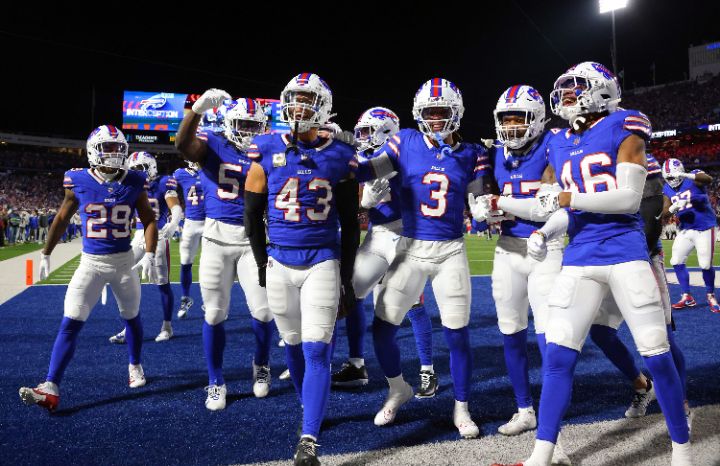
The Buffalo Bills have made significant strides in reshaping their offense this offseason, but one analyst suggests the team should not stop there. Adding a proven, cost-effective veteran like DeAndre Hopkins could provide the final piece to a receiving corps that is otherwise built on a mix of established talent and unproven potential.
Following a blockbuster trade to acquire DJ Moore, the Bills finally secured the true No. 1 wide receiver that had eluded them in recent years. However, according to Lestyn Harris of BuffaLowDown, the roster would benefit from another experienced presence—one that can be added without disrupting future financial flexibility or forcing the team’s hand in the upcoming NFL Draft.
“Adding a cheaper veteran to provide depth and variety allows them to find a WR in the draft without pressure,” Harris wrote. “They have choices, but the best available and affordable option would be DeAndre Hopkins.”
The logic behind the suggestion is rooted in both roster construction and long-term planning. While the Bills now boast a more formidable group of pass-catchers, the addition of a veteran like Hopkins would serve as a safety net. It would allow the front office to approach the draft with patience, selecting a young receiver only if the right opportunity presents itself, rather than reaching for need.
Hopkins, a five-time Pro Bowler, spent the 2025 season with the Baltimore Ravens, where his role was more limited than at any previous point in his career. He recorded 22 receptions for 330 yards and two touchdowns, a modest stat line that belies his potential as a situational contributor. Now 34 years old, he is no longer the dominant, high-volume target he was during his prime with the Houston Texans and Arizona Cardinals. However, in a reduced role as a No. 3 or No. 4 option, he could offer reliable hands, savvy route-running, and invaluable playoff experience.
Beyond the statistical contributions, Hopkins has demonstrated an interest in Buffalo in the past. While he has recently hinted at a possible reunion with former teammate Kyler Murray—this time with the Minnesota Vikings—the fact that he remains unsigned two weeks into free agency suggests his market has not materialized as expected. That delay could work in Buffalo’s favor, as the longer Hopkins waits, the more willing he may become to accept a team-friendly, short-term deal.
For the Bills, the appeal of such a signing extends beyond the depth chart. Head coach Joe Brady has been vocal about the importance of versatility in his receiving group. Speaking at the NFL Scouting Combine, Brady outlined the traits he values most in wide receivers, emphasizing that skill sets vary widely and that evaluation goes far beyond straight-line speed.
“The biggest thing about wide receiver play is no two receivers are the exact same, so I think understanding their type of skill sets and seeing what those kind of look like in specific drills,” Brady said. “There’s some guys that are naturally quicker. I hope to see that quickness in some of the drills. Some guys are straight line speed that they might struggle in a shuttle drill or what not. But, to me, I like the combine to really understand the personality, what makes them tick.”
A player like Hopkins fits within that philosophy. Though his athletic testing days are behind him, his technical mastery, body control, and ability to win in contested situations are traits that do not decline with age as rapidly as pure speed. In an offense that already features DJ Moore as the primary target, along with Khalil Shakir’s reliability in the slot and Keon Coleman’s developmental upside, Hopkins could serve as a situational weapon—particularly in the red zone and on critical third downs.
Buffalo’s current receiver room includes Moore, Shakir, Coleman, Joshua Palmer, and Mecole Hardman. While that group offers a blend of youth, speed, and experience, it lacks a proven veteran presence who has consistently performed in high-stakes playoff environments. Hopkins, despite his reduced production in Baltimore, has played in some of the league’s biggest games and has maintained a reputation as one of the most dependable pass-catchers of his generation.
Hopkins has also made it clear that he intends to continue playing. In a recent interview with TMZ, he acknowledged that while he remains selective about his next opportunity, his passion for the game has not faded. His comments about reuniting with Kyler Murray reflected loyalty to a former teammate, but they did not close the door on other potential suitors. For a Bills team that has made it clear it is operating in win-now mode, adding a player of Hopkins’ caliber—even in a complementary role—would send a signal that no stone is being left unturned in pursuit of a Super Bowl.
From a financial standpoint, the move makes sense for both sides. Hopkins is unlikely to command the lucrative contracts he once did. The Bills, who have managed their salary cap carefully in recent years, could offer a one-year deal with minimal guaranteed money, allowing Hopkins to rehabilitate his market value while contributing to a contender. For Buffalo, such a contract would carry little long-term risk while providing immediate insurance in the event of injuries or inconsistent production from younger players.
The draft remains another avenue for adding talent, but relying on a rookie to contribute immediately in a Super Bowl-or-bust season carries inherent uncertainty. By signing Hopkins now, the Bills would eliminate any pressure to prioritize wide receiver early in the draft, freeing them to address other needs such as defensive line, secondary depth, or offensive line reinforcement.
Ultimately, the argument for signing Hopkins is one of pragmatism. He represents a low-cost, high-upside addition who fits both the team’s competitive timeline and its need for experienced depth. With the receiver still available and the Bills holding a clear vision for their offense, the conditions appear favorable for a reunion of sorts—not with a former team, but with a contender that could offer one of the best opportunities of his late-career renaissance.
As the offseason progresses and the draft approaches, Buffalo’s front office will continue to weigh its options. But for a team that has made aggressive moves to close the gap in the AFC, adding a player of DeAndre Hopkins’ pedigree on a budget-friendly deal may be too sensible an opportunity to pass up.