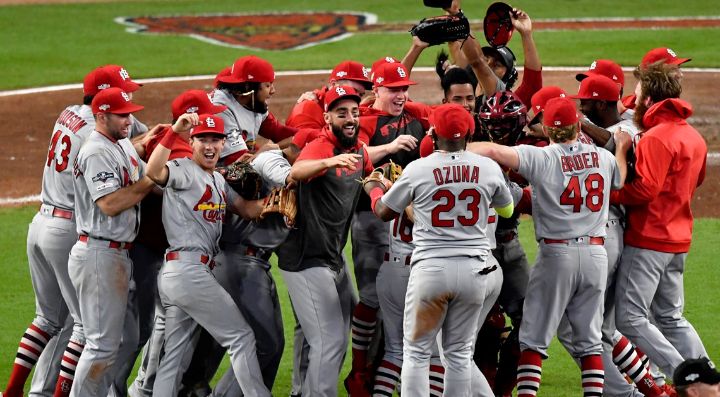
The St. Louis Cardinals entered the new season in a position that feels unfamiliar to longtime fans. After decades of sustained competitiveness, the franchise has finally committed to what appears to be a full-scale rebuild. Early results have reflected that transitional phase, as the team split its first four games of the season, sitting at 2–2. While that record is neither alarming nor impressive, it highlights a team still searching for identity and consistency.
One of the more intriguing storylines coming out of spring training involved outfielder Nelson Velazquez. Signed late in the offseason to a minor league contract, Velazquez quickly turned heads with his offensive production. At 27 years old, he delivered one of the most impressive spring performances on the roster, hitting .357 with four home runs, 10 RBIs, and an eye-catching 1.116 OPS. His ability to drive the ball and provide right-handed power seemed to align perfectly with one of the Cardinals’ most obvious needs.
Given those numbers, many expected Velazquez to secure a spot on the Opening Day roster. Instead, the Cardinals made the surprising decision to leave him off the team and send him to the minors. The move raised immediate questions among fans and analysts alike. Why would a team in need of power leave one of its hottest hitters off the roster?
The answer appears to lie in a combination of caution, long-term planning, and skepticism about small-sample performance.
Throughout the offseason, the Cardinals made it clear they were looking for a right-handed hitting outfielder who could add power to their lineup. Velazquez seemed to check every box during spring training. However, the organization is not fully convinced that his success in exhibition games will translate into meaningful production during the regular season.
Spring training statistics can often be misleading. Players frequently face inconsistent levels of competition, and small sample sizes can inflate performance. The Cardinals appear to be taking that into account. Rather than making a decision based solely on a few weeks of strong hitting, they want to see Velazquez sustain that level of performance over a longer period, particularly against more consistent pitching in the minor leagues.
This approach reflects a broader organizational philosophy. The Cardinals are not simply trying to win games in the short term; they are attempting to build a sustainable foundation for the future. That means evaluating players carefully and avoiding rushed decisions that could backfire later.
Another factor influencing the decision is roster flexibility. Velazquez is in a unique position because he does not have any minor league options remaining. This means that once he is added to the major league roster, the team cannot freely send him back down without exposing him to waivers. In a rebuilding year where the Cardinals are still experimenting with different lineups and player combinations, maintaining flexibility is crucial.
By keeping Velazquez in the minors for now, the team preserves its ability to make adjustments without being locked into a potentially premature commitment. It also allows them to give opportunities to other players already on the roster.
One such player is Thomas Saggese, who has been receiving playing time in the outfield. The Cardinals appear interested in evaluating what they have internally before making additional moves. In a rebuilding season, giving younger or unproven players a chance to develop at the major league level is often just as important as winning games.
At the same time, the decision does not necessarily reflect a lack of belief in Velazquez. In fact, it could be interpreted as the opposite. By asking him to prove himself over a longer stretch, the Cardinals are setting a higher standard—one that, if met, could lead to a more meaningful and stable role in the future.
There is also the matter of timing. The Cardinals are dealing with injuries that could eventually open the door for Velazquez. One notable absence is Lars Nootbaar, who is recovering from offseason surgery on both heels. His eventual return will impact the team’s outfield rotation, but until then, the Cardinals have some room to experiment with different combinations.
If Velazquez continues to perform at a high level in the minors, it is hard to imagine the team keeping him there for long. Power hitting is a valuable commodity, especially for a team that has struggled in that department. Should the Cardinals find themselves lacking offensive production, Velazquez could quickly become an appealing solution.
The situation ultimately comes down to patience. For Velazquez, it is an opportunity to prove that his spring training success was not a fluke. For the Cardinals, it is a chance to gather more data before making a decision that could impact the roster for the rest of the season.
While some fans may view the move as overly cautious, it aligns with the realities of a team in transition. Rebuilding is rarely a straightforward process. It involves difficult decisions, calculated risks, and a willingness to prioritize long-term success over short-term excitement.
In this case, the Cardinals have chosen to take the conservative route. Rather than immediately rewarding a strong spring performance, they are asking for consistency and durability. It is a strategy that may not generate headlines in the moment but could pay off if it leads to more informed decisions down the line.
Still, the story of Nelson Velazquez is far from over. If anything, this decision adds another layer of intrigue. Will he continue his hot hitting in the minors and force the Cardinals’ hand? Or will the team’s cautious approach prove justified?
As the season unfolds, all eyes will be on Velazquez’s performance and the Cardinals’ evolving roster decisions. In a year defined by change, his journey could become one of the most compelling narratives to watch.
For now, the message from the Cardinals is clear: potential alone is not enough. They want proof, consistency, and confidence that a player can contribute at the highest level before handing him a significant role. Whether Velazquez meets that challenge will determine how soon—and how prominently—he fits into the team’s future plans.