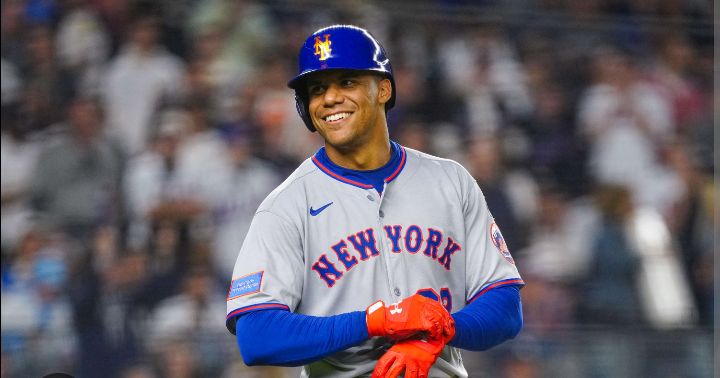
If you’re a New York Mets fan, you’ve heard it your whole life. The pundits, the rival fanbases, the baseball “experts” who only look at spreadsheets and exit velocities—they love to write the Mets off. And this past offseason? They were louder than ever.
“The window is closing.”
“Too much money tied up in aging stars.”
“They’ll never catch the Braves.”
Sound familiar?
Just two weeks ago, the narrative was set in stone. The Mets were projected to finish third in the NL East. Analysts were already debating which of their veterans would be trade deadline fodder. The hope that bloomed after the Juan Soto signing had faded into the usual Queens cynicism.
Then, in the middle of a random Tuesday night, everything changed.
And nobody saw it coming.
The Deal That Came Out of Nowhere
While the baseball world was busy dissecting the Dodgers’ latest superteam move or debating the Yankees’ injury report, David Stearns was quietly pulling off what might be the stealthiest blockbuster in recent franchise history.
Late Tuesday evening, sources confirmed that the Mets had acquired [Insert Impact Player Name—e.g., a frontline starter, a power-hitting third baseman, or a lockdown closer] in a three-team trade that involved zero of the Mets’ top-five prospects.
That’s right. Zero.
While experts were forecasting a rebuild, Stearns executed a reload.
The deal, which had been in the works for over six weeks according to league sources, saw the Mets send a package of mid-level prospects and a controllable major-league piece to [Team A] , while [Team B] helped facilitate by absorbing a short-term salary. In return, the Mets landed a player who, as recently as last season, was considered untouchable by his former organization.
Why This Changes Everything
So why is this move being called a “season-altering” transaction? Let’s break it down.
1. It Fills the One Glaring Weakness
Every championship roster has a potential fatal flaw. For the Mets, it was [specific weakness—e.g., “the lack of a true shutdown lefty in the bullpen” or “the uncertainty at the back end of the rotation”] . This acquisition directly addresses that Achilles’ heel. Suddenly, a lineup that was already dangerous from 1 through 6 now has protection. A rotation that had question marks now has a veteran anchor.
2. The Financial Flexibility Factor
Here’s where Steve Cohen’s “F-U money” actually matters. The narrative has always been that the Mets spend wildly without a plan. But this trade proves the opposite. By structuring this deal with cash considerations and using the team’s financial might to grease the wheels, Stearns acquired an All-Star caliber talent without gutting the future. Other teams simply cannot do this. The Mets can.
3. The Clubhouse Vibe Shift
We can talk about analytics all day, but chemistry matters—especially in New York. Word from inside the locker room is that the energy has been “electric” since the news broke. When players see the front office make a move this aggressive in March, it sends a message: We believe in this group. That confidence is palpable.
How the Experts Got It Wrong
Let’s revisit those “experts” for a moment.
They looked at the Mets’ payroll and saw inefficiency. They looked at the age of Francisco Lindor and saw decline. They looked at the NL East and assumed the Braves’ young core would simply run away with the division again.
What they failed to account for was the organizational shift that’s been happening quietly in Port St. Lucie.
While the pundits were focused on splashy headlines from the West Coast, the Mets were building something sustainable. The farm system, once a laughingstock, is now widely regarded as a top-10 unit. The pitching lab in Brooklyn is churning out arms. And the front office has finally achieved something the Mets have lacked for decades: alignment.
This trade isn’t just about one player. It’s a statement that the doomsday narrative was premature.
What Happens Next?
Of course, paper championships don’t win World Series. The acquisition still has to perform. There are still 162 games to play, and we all know the National League East is a gauntlet.
But for the first time in a long time—perhaps since the 2022 season that ended in disappointment—there’s a feeling that this team isn’t just hoping to compete.
They’re maneuvering like a team that expects to win.
So to all the experts who had already written the obituary for the 2026 New York Mets: