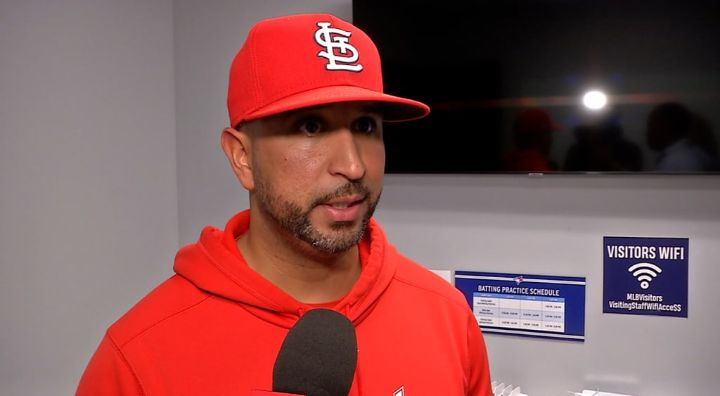
As the St. Louis Cardinals finalize their preparations for the 2026 season, one of the most intriguing storylines of the spring is the emergence of infield prospect JJ Wetherholt. It is now all but assured that Wetherholt will break camp with the major league club and be on the roster for Opening Day. His performance in Jupiter has left the coaching staff with little choice but to include him, but a significant question remains: once he’s in the lineup, where should he hit?
The team has experimented heavily this spring, slotting Wetherholt into the leadoff position for several games. The early returns have been promising, showcasing the on-base skills and gap power that made him a top prospect. However, the transition from a successful spring stint to the grind of a 162-game regular season is a massive leap, and the leadoff role carries its own unique set of pressures and responsibilities. The question facing manager Oli Marmol and his staff is whether to throw Wetherholt directly into the fire at the top of the order or to ease him in further down the lineup.
The Case for Wetherholt at Leadoff
The most compelling argument for installing Wetherholt as the everyday leadoff man is simply that he has a proven track record of success in the role. A look at his professional history reveals a player accustomed to setting the table. During his time at West Virginia University and throughout his rapid ascent through the Cardinals’ minor league system, Wetherholt has batted almost exclusively in the top three spots in the order. This is not a player being asked to learn a new position on the fly; this is a role he has performed his entire career.
The evidence became even more pronounced after his promotion to Triple-A Memphis on July 7, 2025. Once he joined the Redbirds, Wetherholt was frequently installed as the leadoff man. The result was a powerful display of offensive production, as he hammered five leadoff home runs over the remainder of the minor league season. This demonstrates not only an ability to get on base but also the kind of pop that can change the complexion of a game from the very first at-bat. For a Cardinals team that has often struggled to generate consistent offense in recent years, having a leadoff hitter who can create instant offense is a tantalizing prospect.
Furthermore, a deep dive into the advanced metrics and on-base percentages makes the decision seem even more straightforward. The primary job of a leadoff hitter is to get on base and create opportunities for the heart of the order. In this regard, Wetherholt excels. His minor league track record is highlighted by a robust .421 on-base percentage when hitting at the top of a lineup. This is not a small-sample-size anomaly; it reflects a disciplined approach at the plate, a keen eye for the strike zone, and the ability to work counts deep.
The Counterargument: Protecting a Young Player
The opposing viewpoint is rooted in a more traditional, cautious approach to player development. The concern is that heaping the responsibility of the leadoff spot onto a rookie could be counterproductive. The logic suggests that by starting the season with Masyn Winn at the top of the lineup, the Cardinals could allow Wetherholt to hit lower in the order, perhaps sixth or seventh, where he can get comfortable facing major league pitching on a daily basis without the added weight of being the table-setter. In this scenario, he would have to “earn” his way into the leadoff role by proving he can handle big-league pitching over an extended period.
On the surface, this argument has merit. Protecting young players from unnecessary pressure is a hallmark of many successful player development systems. However, this plan falls apart when you scrutinize the alternative. Masyn Winn, for all his defensive brilliance and promising bat-to-ball skills, has not performed well as a leadoff hitter. In his opportunities at the top of the St. Louis lineup, he has managed an on-base percentage of just .290. Plugging Winn into the leadoff spot would essentially be sacrificing offensive production at a crucial lineup position for the sake of shielding Wetherholt.
When you directly compare the two, the choice becomes clear. Winn’s .290 OBP in the leadoff spot is a significant liability, while Wetherholt’s .421 OBP in the same role is an elite asset. The goal of any lineup is to maximize runs, and starting the game with a .421 OBP guy creates far more scoring opportunities than starting with a .290 OBP guy. The “earn it” philosophy is admirable in theory, but not when the alternative is statistically inferior.
Handling Adversity and Exploring Other Options
A lingering question about any rookie is how they will respond to their first extended slump. The concern about having Wetherholt in the leadoff role is the potential fallout if he struggles for a few weeks. Will the pressure of the role compound the natural difficulties of adjusting to the majors? This is a valid concern, but it is also one that Wetherholt’s makeup suggests is manageable. Throughout his rapid ascent, he has consistently displayed the ability to make intelligent, in-game adjustments. He does not project as the type of personality that will wilt under the bright lights. The Cardinals’ front office has also stated that 2026 is a year focused on player development and evaluating the future core. This organizational philosophy provides the perfect cover to commit to Wetherholt at the top of the lineup, allowing him to play through growing pains without the immediate threat of being demoted or moved down in the order.
Finally, one must consider the other theoretical options for the leadoff spot. The well-liked Lars Nootbaar, when healthy, has been floated as a candidate, but his career on-base percentage sits at a respectable but unspectacular .341. Victor Scott II, with his game-changing speed, would be an ideal leadoff man in theory, but his on-base percentage of just .283 at the major league level makes him a liability rather than an asset at the top of the order. A leadoff hitter who doesn’t get on base neutralizes his own greatest weapon: his speed.
When you survey the entire roster, no other player presents a better combination of on-base skills, contact ability, and burgeoning power for the leadoff spot than JJ Wetherholt. He is comfortable in the role, his skillset is perfectly suited for it, and the team’s developmental focus for the season allows for the patience he might need. The St. Louis Cardinals should stop experimenting and commit to JJ Wetherholt as their leadoff hitter for 2026 and beyond.