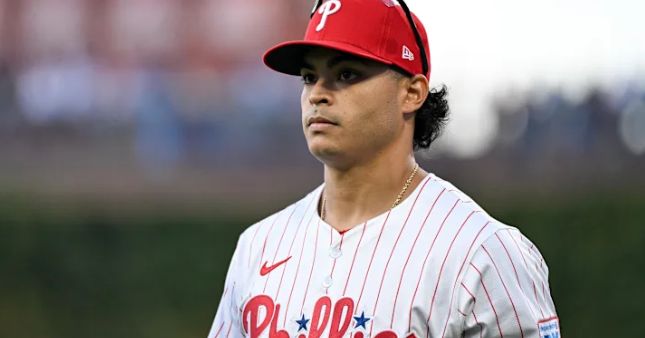
Jesus Luzardo’s salary increase with the Philadelphia Phillies will be balanced out by other financial moves.
The recently reported five-year, $135 million extension for left-hander Jesus Luzardo is structured to begin taking effect next season.
For the 2026 campaign, Luzardo is currently slated to make $11M following the contract he signed in January to avoid arbitration in his final year before free agency. Once his new extension activates in 2027, his annual salary will rise to $27M. This figure, representing the deal’s average annual value, is what counts toward the Competitive Balance Tax (CBT) calculation.
The Phillies have consistently exceeded the CBT threshold, surpassing it by $73 million last season and starting 2026 slightly over that mark again. As repeat offenders for four consecutive years, they face the most severe tax penalties. Their tax bills have escalated significantly over the years, from roughly $3M in 2022 to approximately $56M last season, driven by high payrolls and free-agent spending.
An Uncertain Future Landscape
However, the future structure of MLB’s financial rules is uncertain. The current Collective Bargaining Agreement is set to expire on December 1st, and a lockout is anticipated. Whenever the 2027 season begins, the CBT system—including its thresholds and penalties—could be substantially altered.
The Significance of Contract Timing
When comparing Luzardo’s $135M deal to Ranger Suárez’s recent $130M contract with the Boston Red Sox (both over five years), fans naturally questioned why the Phillies didn’t allocate those funds to Suárez.
Beyond the differences in the pitchers’ skill sets, age, and potential, the timing of the contracts is a key factor. Had the Phillies committed to a starting pitcher with a similar annual value for the 2026 season, they would be absorbing nearly double the cost. Their CBT payroll is already hovering around $315M this year.
Crucially, Luzardo’s pay increase from $11M to $27M doesn’t start until 2027. By that time, a significant amount of money will be coming off the Phillies’ books after the 2026 season concludes.
Contracts Expiring After 2026
· Nick Castellanos is set to earn $20M in 2026.
· Taijuan Walker is due $18M.
· Alec Bohm is scheduled to make $10.2M and appears likely to test free agency. Depending on the season’s outcome, top prospect Aidan Miller could potentially take over at third base in 2027, saving the team approximately $9.5M at that position. (Miller must first recover from lingering back soreness.)
· Adolis García is on a one-year, $10M deal for 2026.
· Other Phillies in their final year before free agency include José Alvarado ($9M) and Edmundo Sosa ($4.4M).
The combined savings from Castellanos and Walker alone total $37.2M. If Bohm is replaced by Miller, that figure rises to $46.6M. Should Alvarado, García, and Sosa also depart, the reduction in payroll could reach as high as $70M, though letting all three go might not be the preferred outcome.
Even with the most conservative savings estimate of $37.2M, Luzardo’s $16M raise covers less than half of that freed-up space. In a scenario where either Bohm is replaced or García departs, the Phillies would still have roughly $30M available to potentially pursue a star free agent.
That said, next year’s free-agent class doesn’t present an obvious positional fit for the team. The outfield market appears relatively weak, headlined by a 37-year-old George Springer, Randy Arozarena, and Seiya Suzuki, whose defense has declined rapidly.
Current Payroll Context
For the 2026 season, the first CBT threshold is $244M, while the fourth tier—carrying the stiffest penalties—is set at $304M. The Phillies’ current payroll is estimated at around $315M, which would result in a tax bill of approximately $54M. These figures are finalized by MLB at the end of the season, leaving time for adjustments.
The team’s payroll picture is expected to normalize in 2027 following the removal of the Castellanos and Walker contracts. Subsequently, Zack Wheeler’s substantial $42M AAV will come off the books after the 2027 season.
The 2026 season was always projected to be the most financially challenging for the Phillies to navigate. This context explains their recent reluctance to pursue moderate upgrades, instead focusing on making a significant move for a player they deemed both worthy and an ideal fit, such as Bo Bichette.
In short, Luzardo’s significant salary increase does not affect the Phillies’ budget this year, and by the time it does, it will be effectively counterbalanced by other expiring contracts.