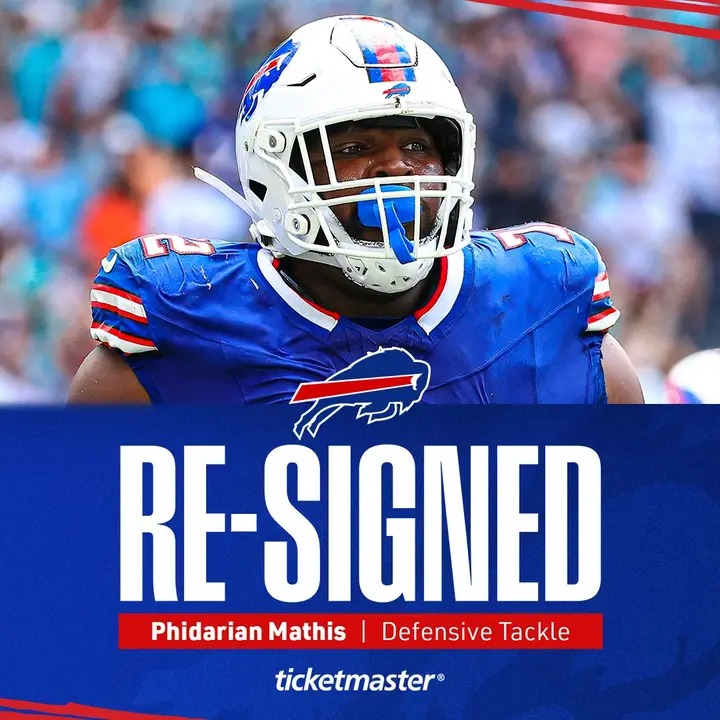
The Buffalo Bills made a pair of under-the-radar but significant roster moves this week, announcing the re-signing of offensive lineman Alec Anderson and defensive tackle Phidarian Mathis to one-year contracts. While neither player is a household name on the national stage, both moves represent the kind of depth-building transactions that are critical for a team with Super Bowl aspirations navigating a tight salary cap. By bringing back these two exclusive rights free agents, the Bills solidify their roster infrastructure with young players who are already familiar with the system.
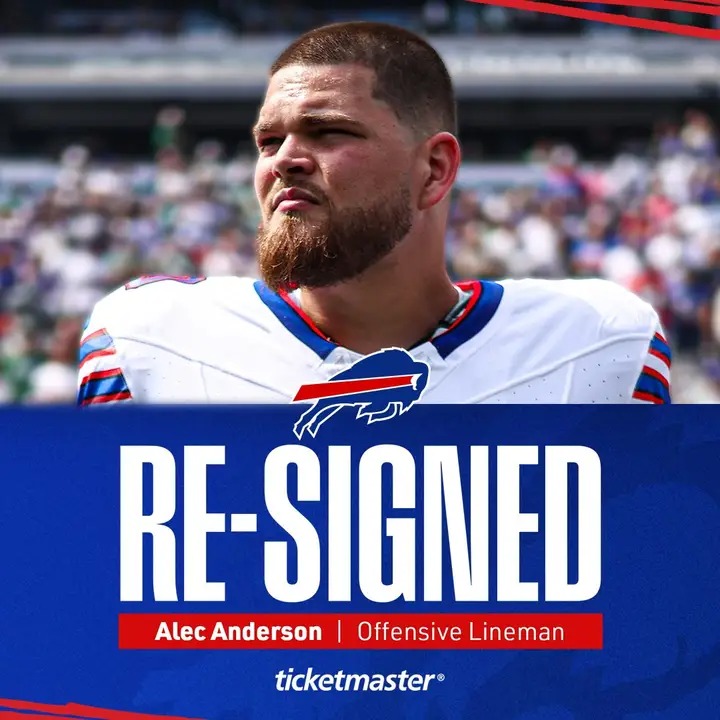
For Alec Anderson, the journey back to Buffalo is a testament to perseverance and development. Originally signed as an undrafted free agent out of Fresno State in 2023, Anderson spent his rookie season on the practice squad, learning the intricacies of the NFL game. His hard work paid off in 2024 when he earned a promotion to the active roster. While he didn’t see significant regular-season action on offense, his value to the team became evident in his role as a versatile backup. Anderson’s ability to play multiple positions along the offensive line—having experience at both guard and tackle—makes him a valuable asset in practice and a reliable insurance policy on game day. Coaches often praise players who can step into multiple roles, and Anderson fits that mold perfectly. His re-signing ensures that the Bills retain a young, cost-effective lineman who has spent two years absorbing the playbook and building chemistry with his teammates, rather than having to start from scratch with an unknown free agent.
On the defensive side of the ball, the re-signing of Phidarian Mathis carries a slightly different context but is equally important. A second-round draft pick by the Washington Commanders in 2022, Mathis was highly touted coming out of Alabama, where he was a dominant force on a championship-caliber defense. Unfortunately, his NFL career got off to a rocky start when he suffered a torn meniscus in his very first game as a rookie, sidelining him for almost the entire season. He spent the next two years in Washington trying to find his footing but never quite lived up to his draft stock in a crowded defensive line room. The Bills claimed him off waivers in August of 2024, hoping that a change of scenery and a fresh start in Sean McDermott’s defense could unlock the potential that made him a top-50 pick.
In Buffalo, Mathis found a role as a rotational interior lineman. While he didn’t post gaudy statistics, he provided valuable snaps in the middle of the defensive line, eating up blocks and contributing against the run. At 6-foot-4 and 312 pounds, Mathis brings a powerful, physical presence to the trenches. Re-signing him to a one-year deal is a low-risk, high-reward move for the Bills. It gives him a full offseason to work with defensive line coach Marcus West and to fully integrate into the system without the pressure of learning on the fly during training camp. For a Bills team that has seen familiar faces like DaQuan Jones and Jordan Phillips depart in recent years, maintaining a steady rotation of fresh, young linemen is crucial for keeping the defense stout against physical AFC opponents.
From a broader team-building perspective, these signings exemplify General Manager Brandon Beane’s approach to roster management. In an era where the salary cap is perpetually tight—especially with a franchise quarterback like Josh Allen commanding a significant portion of it—teams must find value in the margins. Exclusive rights free agents like Anderson and Mathis are among the most cap-friendly players in the league. By re-signing them, the Bills can fill out the bottom of their 53-man roster with players who have already proven they can contribute on special teams or in rotational roles, rather than spending limited funds on veteran free agents who might demand higher salaries and guaranteed money.
Furthermore, continuity is an often-overlooked aspect of success in the NFL. The Bills have built a culture centered on accountability, hard work, and a “next man up” mentality. Players like Anderson, who have grinded on the practice squad, and Mathis, who is looking to revive his career, embody that culture. They know the practice schedule, they know the coaching staff’s expectations, and they have established relationships in the locker room. This familiarity can be a subtle advantage during the grueling training camp and the marathon that is the NFL season.
Looking ahead, both players will have the opportunity to compete for expanded roles when the team gathers for organized team activities and training camp. For Anderson, the path to the roster likely runs through his versatility as a swing backup, but if injuries occur, he could find himself in contention for a starting guard spot. For Mathis, the opportunity is even more tangible. With the defensive line always in need of fresh legs to rotate through, a strong camp could see him earn a career-high in snap counts, potentially setting himself up for a bigger payday in the future.
In conclusion, while the re-signing of Alec Anderson and Phidarian Mathis may not make national headlines or satisfy fans hoping for a blockbuster trade, these are the precise moves that build a championship-caliber foundation. They are investments in depth, youth, and familiarity. As the Bills continue to retool their roster for another run at the Super Bowl, securing reliable players who understand the team’s mission is just as important as adding star power. Anderson and Mathis will now have the chance to prove that the Bills’ faith in them was well-placed as they prepare for the 2025 season in Buffalo.