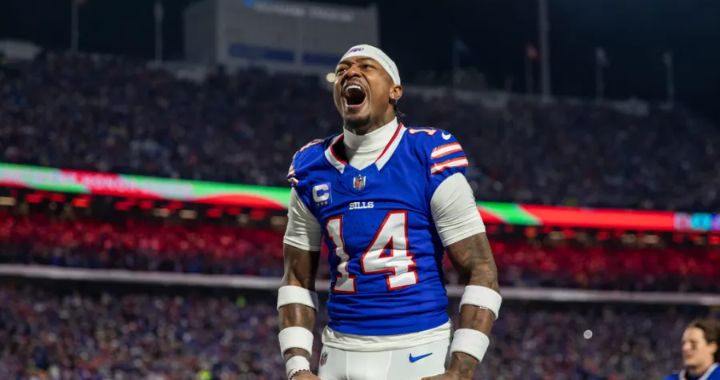
The cacophony of Super Bowl week is a unique form of madness. A sensory overload of flashing lights, repetitive questions, and the metallic hum of history being forged. Amidst this controlled chaos, in a momentary pocket of startling clarity, Stefon Diggs brought the noise to a standstill. The star wide receiver, now adorned in the colors of his new team, did not look forward to the legacy he might cement this Sunday. Instead, he turned, with a palpable and emotional gravity, to the one he left behind.
“If we get this done,” Diggs began, his voice measured yet thick with intent, pausing as if mentally tracing the route from this gleaming stadium back to the wind-whipped tunnels of Highmark Stadium. “This one is for Buffalo. Straight up. That’s not just a quote; that’s a fact. My whole career, who I became as a player, the man I am on this stage… that was born in Buffalo. The fans, my brothers in that locker room, the city that wrapped its arms around me and showed me what real passion is—they built this. They built me.”
The statement, delivered not as a throwaway line but as a solemn vow, landed like a depth charge in the shallow waters of pre-game clichés. In the transactional world of the NFL, where loyalties are traded with contracts, Diggs’ promise to dedicate a potential championship to a former team is a profound anomaly. It is an act of emotional archaeology, digging through the layers of a bitter, headline-dominated departure to unearth and honor the foundational bedrock of his stardom.
The Crucible of Buffalo
To understand the weight of this dedication, one must revisit the alchemy that occurred when Stefon Diggs arrived in Buffalo in 2020. He was already a good player—the author of the “Minneapolis Miracle,” a talented receiver with a flair for the dramatic. But in Buffalo, he was transmuted into something else: a superstar, a culture-driver, the alpha in Josh Allen’s explosive ascension.
In Buffalo, Diggs found more than a quarterback; he found a symbiosis. He was the precision to Allen’s chaos, the reliable endpoint to those improbable, cross-body rockets. In his first season, he led the league in receptions and receiving yards, not as a stat-padder, but as the centerpiece of an offense that dragged a dormant franchise into the modern era. The Bills Mafia, a fanbase defined by its resilient, blue-collar fury, didn’t just cheer for him; they adopted him. They saw in his fiery competitiveness, his meticulous route-running, and his unapologetic desire to win a reflection of their own spirit.
“He gave us permission to believe,” said longtime Bills season-ticket holder, Eleanor Chen, from her home in Orchard Park. “Before Josh and Stef, we hoped to be competitive. With them, we expected to win. He brought a swagger we hadn’t earned in decades. He made Buffalo a destination.”
But this fairy tale had a thorny third act. The pursuit of the ultimate prize became a tightening knot of pressure. The “13 seconds” loss in Kansas City was a collective trauma. As the following seasons ended in similar, heart-wrenching fashion in the Divisional Round, the narrative shifted. Diggs’ visible frustrations on the sideline, once celebrated as passion, were increasingly framed as dysfunction. The whispers about his relationship with Allen and the coaching staff grew into a media roar. The 2024 offseason trade, while a shock in its timing, felt like an inevitable, painful divorce.
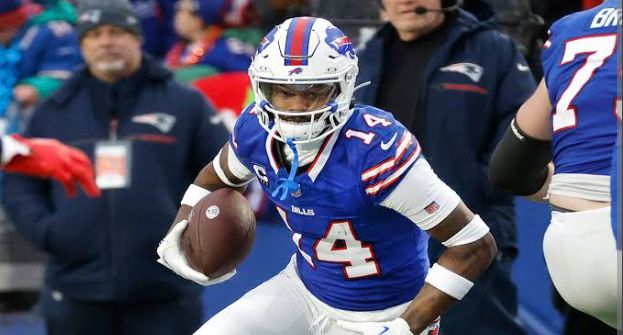
The Aftershock and the Reflection
The trade was a seismic event for both franchises. For Diggs’ new team, it was the acquisition of a final, elite piece for a championship puzzle. For Buffalo, it was the amputation of a beloved, if occasionally fevered, heartbeat. The fanbase fractured—some feeling betrayed by his perceived attitude, others devastated that the front office failed to maintain a championship-caliber weapon for their franchise quarterback.
In the months that followed, Diggs largely remained silent on the details, allowing the business of football to be just that: business. But here, on the grandest stage, with nothing left to prove about his value and no need for political posturing, the truth of his heart spilled out.
“Everybody wants to talk about the exit, the business,” Diggs continued, his gaze steady. “But I choose to talk about the arrival, the growth, the love. Buffalo is where I got the fame, yeah, but more than that, it’s where I found my voice as a leader. It’s where we revived a belief. We fell short, but that chapter… that chapter made me hungry enough to be standing here right now. That hunger you see? That was forged in those January snows.”
This is more than gratitude. This is a full-throated recognition that legacy is not a single destination, but a path. The Diggs that will line up on Sunday—the nuanced route technician, the big-moment savant, the vocal leader—is a product of the Buffalo crucible. The disappointments there did not break him; they tempered him. The pressure did not crumble him; it compacted his resolve into a diamond-hard focus.
A Ripple Across Two Fanbases
The reaction from Buffalo has been a powerful wave of catharsis. Social media, once a battleground of bitter debate, has flooded with messages of appreciation from Bills Mafia. Diggs’ promise has served as a salve, reframing the entire narrative from one of acrimony to one of a bittersweet, but ultimately loving, football family split apart by the harsh realities of a hard cap and a closing championship window.
“It’s classy, it’s raw, and it’s 100% Stef,” said Michael Russo, a Bills fan from West Seneca. “For weeks after the trade, all we heard was the noise. This… this is the signal. It hurts that he’s not hoisting it here, but knowing he still carries us with him, that he acknowledges what we built together? Man, that mends a lot of fences.”
For his current teammates and fans, the comment is a revealing glimpse into the soul of their new weapon. It speaks to a loyalty and depth of character that transcends jersey colors. It confirms they didn’t just acquire a talented receiver, but a consummate professional who understands the weight of history and community in the sport.
“That’s the kind of dude he is,” said his new quarterback, when asked about Diggs’ comments. “He carries everyone with him. It just tells you how real he is. We want to win this for our city, for this locker room. And if a part of that victory also honors a chapter of his journey that got him here, then that just makes it more special.”
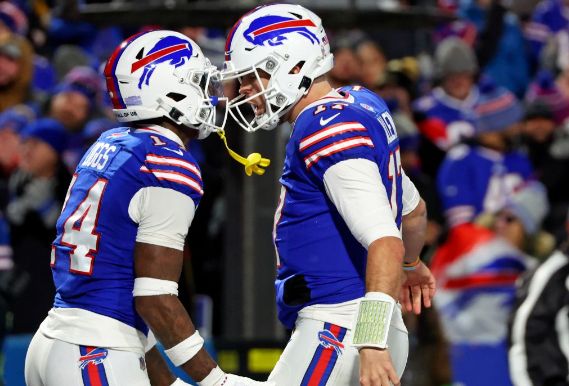
The Weight of the Promise
As Sunday approaches, the stakes have been personally elevated for Stefon Diggs. He is not only playing to etch his name in the annals of his current franchise or to silence any remaining doubters. He is playing to fulfill a public vow, to send a piece of the Lombardi Trophy emotionally back to a city that resides over 2,000 miles away.
The pressure is immense, but it is precisely the kind of pressure he learned to navigate in Buffalo. Every critical third down, every end-zone fade, every moment where the game hangs in the balance will now be filtered through this dual lens. He is playing for the now, and for the then.
If his team succeeds, the image will be indelible: Stefon Diggs, confetti in his hair, perhaps holding the trophy, speaking into a microphone and unequivocally naming Buffalo. It would be one of the most poignant and unique dedications in Super Bowl history, a powerful reminder that in a league of ruthless movement, the bonds forged in the struggle are sometimes permanent.
If they fall short, the promise will hang in the air—a testament to an unfinished story, a debt of honor not yet repaid. But regardless of the outcome, Diggs has already accomplished something rare. He has taken control of his own narrative, threading the needle between past and present with grace and raw honesty. He has reminded a jaded sports world that some connections, forged in the fire of shared pursuit and communal hope, cannot be severed by a transaction.
One thing is now unequivocally clear: When Stefon Diggs takes the field on Super Bowl Sunday, he won’t be carrying just the playbook. He’ll be carrying the hopes of two cities—the one that dreams of a present coronation, and the one in Western New York, forever proud, forever heartbroken, and now, unexpectedly, forever remembered.