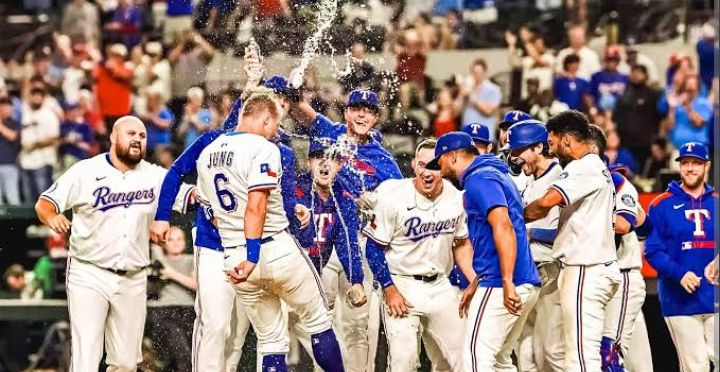
The ever-evolving landscape of Major League Baseball’s offseason is once again ripe with speculation, and one of the most intriguing storylines involves the future of legendary pitcher Justin Verlander. The three-time Cy Young Award winner, now in his forties, has made his intentions clear: he is not ready to hang up his spikes and plans to continue pitching. This declaration has opened the door to a familiar free agency dance, with several clubs—including some from his past—reportedly expressing interest. However, a new and unexpected suitor has entered the conversation, offering a compelling and strategic fit. According to a recent prediction, the reigning American League champion Texas Rangers could be the team to swoop in and secure the services of the future Hall of Famer for the upcoming campaign.
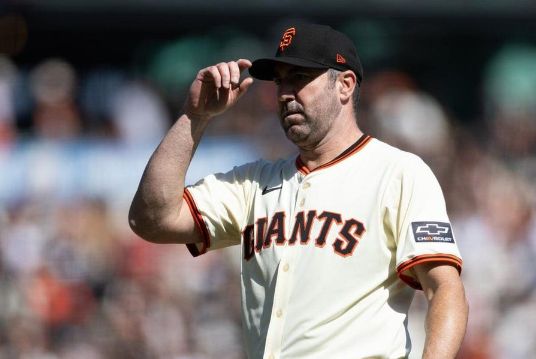
The rumor mill surrounding Verlander has been active, with credible reports from insiders like Ken Rosenthal of The Athletic confirming that the Baltimore Orioles, a young and ascending team with a clear need for frontline pitching experience, have legitimate interest. Furthermore, the speculative narrative often circles back to Verlander’s former homes. A sentimental return to the Detroit Tigers, where he began his career and achieved his first Cy Young and MVP honors, is a popular notion among fans. A reunion with the Houston Astros, with whom he won two World Series rings and another Cy Young, always seems plausible given their perennial contender status. Even the San Francisco Giants, his most recent team, are mentioned as a potential fit. Yet, amidst these familiar narratives, Bleacher Report analyst Zachary D. Rymer has put forward a persuasive case for a different destination: the Texas Rangers.
Rymer’s prediction hinges on the philosophical identity of the Rangers’ organization under the leadership of President of Baseball Operations Chris Young. Young, a former Major League pitcher himself, has consciously constructed the Rangers in a specific image: a team anchored by a dominant and deep starting rotation. This is not merely a casual strategy but a foundational pillar. The results in the recent past speak to this focus. In the previous season, the Rangers’ pitching staff, led by its starters, achieved the remarkable feat of leading the entire American League in earned run average (ERA). This statistical dominance was the engine that drove their deep postseason run. The envisioned core of this rotation for the coming years is both intimidating and star-studded, featuring the electric but oft-injured Jacob deGrom, the playoff-hardened Nathan Eovaldi, and the promising young arm of MacKenzie Gore.
However, within this strength lies the precise rationale for pursuing a pitcher of Verlander’s caliber. As Rymer points out, the “intimidating front three” comes with significant and unavoidable questions regarding durability. Jacob deGrom, while arguably the most talented pitcher in baseball when healthy, has been plagued by injuries over several seasons, making his ability to shoulder a full 30-start workload a constant uncertainty. Nathan Eovaldi has also had his share of injury history, though he has been more reliable in recent years. Relying on both to be fully healthy for an entire season and postseason is a calculated risk. Beyond this top tier, the back end of the Rangers’ rotation presents its own set of uncertainties, with roles likely to be filled by less proven or inconsistent pitchers.
This is where the potential acquisition of Justin Verlander transforms from a luxury into a strategically sound maneuver. Signing Verlander would accomplish two critical objectives for Texas. First, and most directly, it would provide immense stability and quality to the rotation. Even at his advanced age, Verlander represents a model of durability and excellence. His 2025 season, while not otherworldly by his own historic standards, was decidedly solid, evidenced by a 3.85 ERA in a hitter-friendly era. He remains a pitcher who demands respect, possesses a deep arsenal, and has an unparalleled competitive mindset. Slotting him into the rotation, whether as a frontline ace to ease pressure on deGrom or as a supremely reliable number two or three starter, would solidify the entire group. It mitigates the risk associated with deGrom’s health and elevates the floor of the pitching staff considerably.
Secondly, and perhaps more symbolically, acquiring Verlander would represent a powerful affirmation of the Rangers’ organizational identity. As Rymer notes, it would be “tripling down” on their commitment to building a champion through pitching. Signing a future first-ballot Hall of Famer who is still effective sends a resounding message to the clubhouse, the fanbase, and the rest of the league: the Rangers are fully committed to their philosophy and are in win-now mode. Verlander’s presence alone brings a level of credibility, postseason experience, and a winning pedigree that can permeate an entire organization. He has been the ace on championship teams and understands the grind and focus required to navigate a long season and succeed in October. This intangible leadership could be invaluable for a team looking to return to the World Series stage.
For Verlander, the Rangers present an attractive and competitive opportunity. The team is clearly built to win immediately, with a powerful lineup to support its pitchers. The chance to be the final, critical piece for a contender in the American League, potentially facing his former Astros team in a high-stakes rivalry, could be a motivating factor. While a return to a familiar city holds emotional appeal, the competitive and strategic fit with Texas is exceptionally strong.
Justin Verlander’s career resume is the stuff of legend. Since his debut in 2005, he has accumulated over 3,000 strikeouts, a milestone that cements his place among the all-time greats. His mantle holds three Cy Young Awards (2007, 2011, 2019), an American League Most Valuable Player Award (2011), and two World Series championship rings (2017, 2022) with the Houston Astros. He has seamlessly transitioned from a fireballing young ace to a cunning veteran who outthinks hitters as much as he overpowers them. This next chapter, wherever it is written, will add to that legacy.
While the Orioles offer a young, exciting core and the pull of history is strong with his former teams, the Texas Rangers offer a compelling, logic-driven case. They have a direct need, a matching organizational philosophy, and the immediate competitive window that a player like Verlander seeks. If Chris Young and the Rangers’ front office decide to make an aggressive push, they have the potential to pull off one of the offseason’s most surprising and impactful signings, bringing a baseball legend to Arlington with the shared goal of adding one more championship to both their histories.